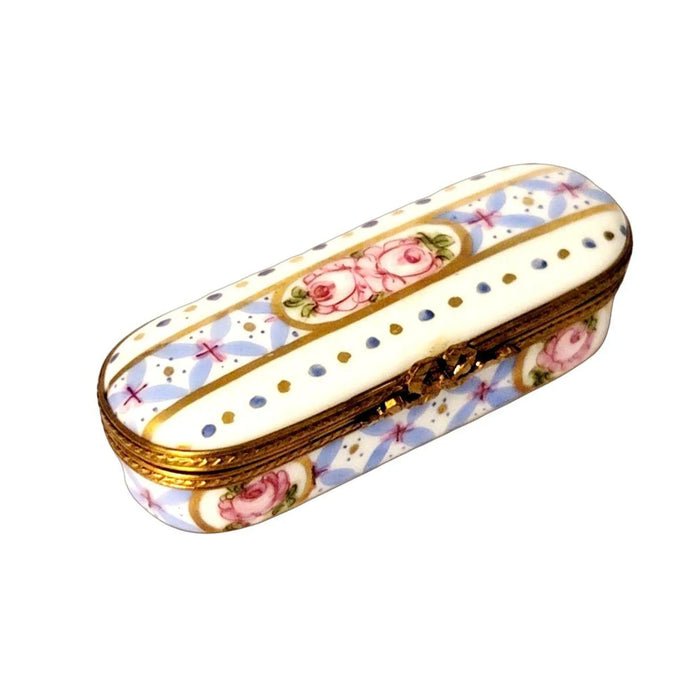
Knowing who made your box helps you check that it’s genuine, find matching sold prices and learn its story. Most of the clues are on the base. Here is how to read them, step by step.
Step 1: Read every mark on the base
Turn the box over under good light and write down every word, logo, initial and number, exactly as it appears. Use a loupe for small or faint marks. Marks are often in two colors, and some may be partly hidden by a felt pad or old sticker.
Step 2: Separate the different kinds of mark
A Limoges box base often carries several different marks, each with its own job:
- The place: “Limoges France” or “Limoges” with “France”.
- The decoration: “Peint Main” (hand painted), “Rehaussé Main” (enhanced by hand) or “Décor Main” (decorated by hand).
- The porcelain factory: often a printed mark under the glaze, sometimes in green.
- The decorating studio or brand: a name, logo or initials, often over the glaze.
- The painter: small initials or a signature.
- The retailer or importer: sometimes a store or company name.
Our guide to reading the marks shows these in more detail.
Step 3: Look for a known brand name or logo
Many boxes carry the name of a well-known Limoges box brand, such as Rochard, Artoria, Chamart, Parry Vieille, La Gloriette or Dubarry. Our page on the makers behind Limoges boxes introduces the main names.
Step 4: Understand boxes with two names
Two names on one base are normal. Usually one company made the white porcelain and another decorated it, or a workshop made the box and a retailer added its own name. A store or importer name tells you where the box was sold. The workshop mark tells you who made or painted it.
Step 5: If there’s no maker’s name
Plenty of genuine boxes carry only “Limoges France” and “Peint Main”, with no brand. In that case:
- Compare the painting style, the shape and the metal clasp with identified boxes in sold listings.
- Search for the exact subject with “Limoges France Peint Main” and browse the results.
- Ask a specialist dealer, who may recognize the style or the clasp.
An unbranded box can still be genuine and lovely; it’s just harder to research.
Step 6: Search smartly
Search for the exact wording of any unusual mark in quotation marks, along with “Limoges”. Look at sold listings and auction records with the same mark and check their photos. Small studios rarely have websites, but their marks show up again and again on boxes sold over the years.
Can’t read the mark? Photograph it with a lamp held low to one side. Raking light often brings faint or worn lettering back into view.
Quick answers
Not always. It may be the decorating studio, the porcelain factory, or the retailer or importer that sold the box. Two or three names on one box are common.
Often a little less, because buyers like a known name, but quality, subject and condition matter more. Many fine boxes carry only “Limoges France” and “Peint Main”.
They’re usually the painter’s initials. They show the box was decorated by an individual artist, and they’re a nice detail for collectors.
This article is general guidance from the team behind LimogesBoutique.com, who have worked with Limoges boxes for more than thirty years. It is not a formal appraisal. For more help, see our Limoges box Q&A.
Leave a Reply