Limoges Box Guide · Shapes & Styles
Limoges Box Shapes and Styles, Explained
From a plain oval pill box to a tiny porcelain piano with a sheet of music inside, here is how to tell the main kinds of Limoges boxes apart and choose the right one.
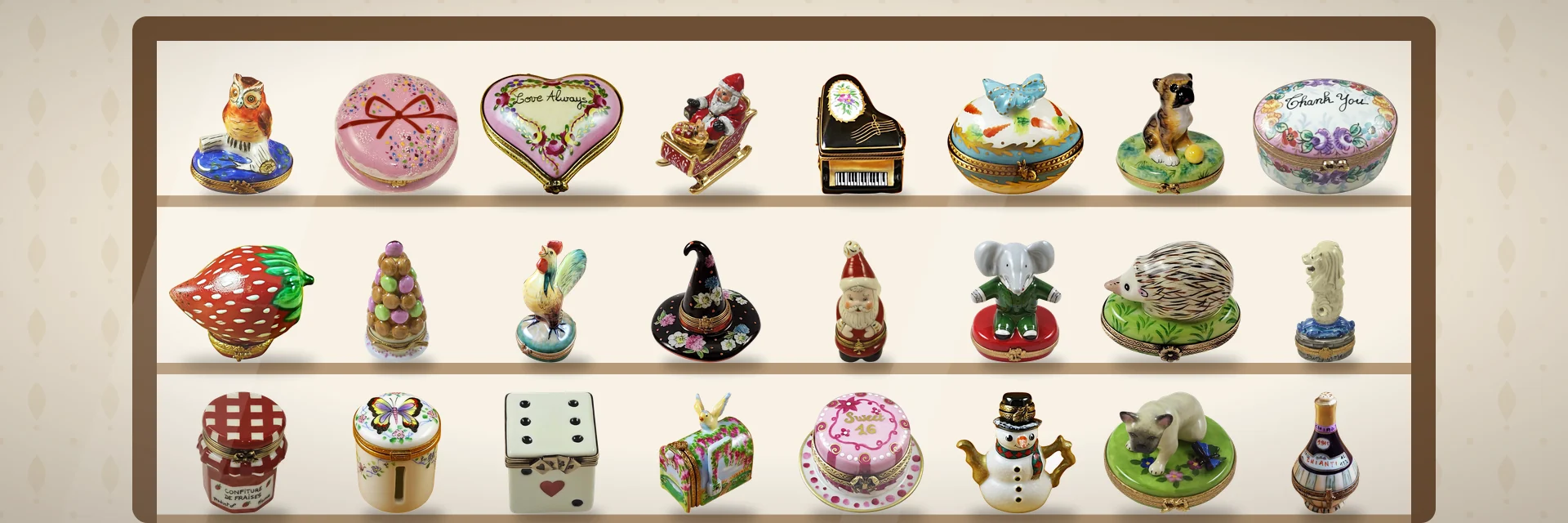
Walk into a shop or scroll a collector’s shelf and you will see two broad families of Limoges boxes. The first is the classic form: a simple geometric shape (oval, round, square, heart) that serves as a canvas for painted flowers, landscapes or patterns. The second is the figural box, molded to look like something: a cat, a croissant, a carousel, a cruise ship.
On this page
Both are made the same basic way, in hard-paste porcelain cast from molds, fired, painted by hand and fitted with a metal hinge and clasp. (For the step-by-step process, see How They’re Made.) What changes from type to type is how much the shape itself tells the story, how much the painter adds, and what extras the maker builds in.
This page walks through the main shapes, the themes collectors look for, the “surprise inside” tradition, sizes, hardware, finishes and editions, and finishes with a short guide to choosing.
The classic forms
Classic shapes are the oldest style. They descend from the snuffboxes, patch boxes and pill boxes of the 1700s and 1800s (see History), and they are still popular because they are elegant, easy to display and easy to use.
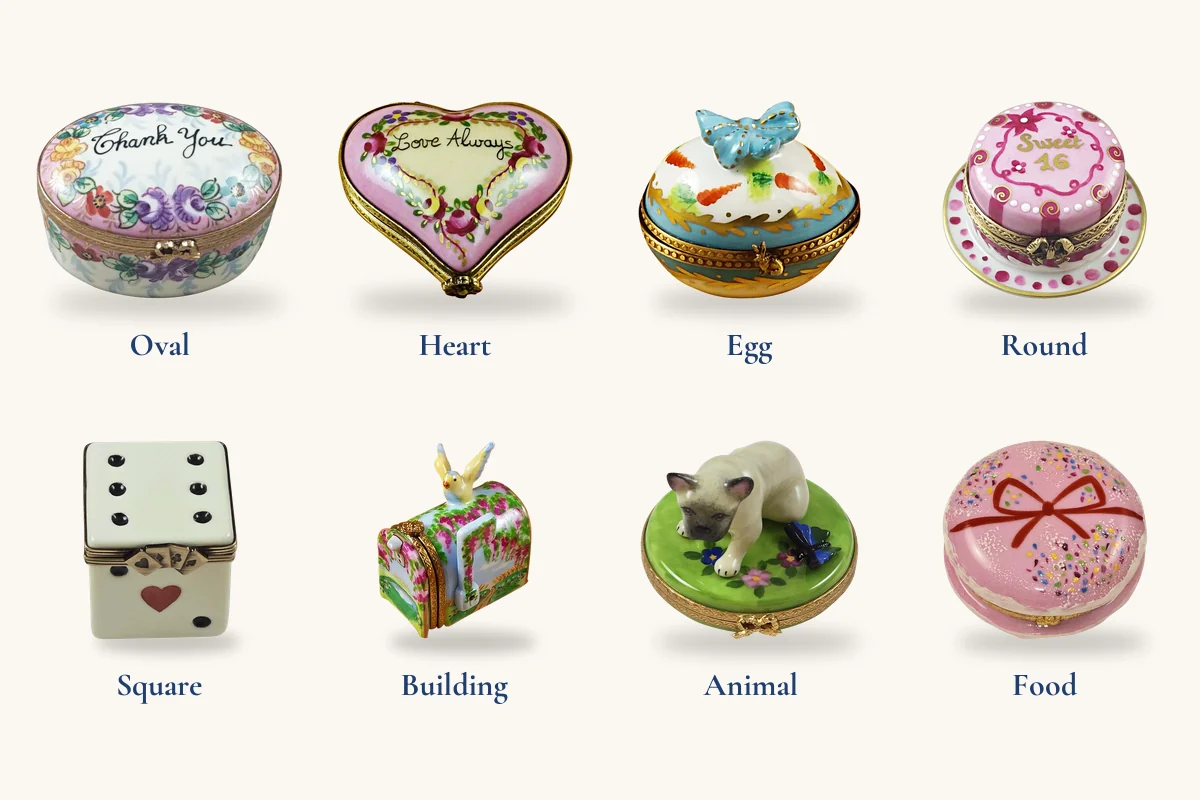
Oval
The oval is the workhorse of Limoges boxes. Its long, gently curved lid gives the painter a generous surface for a bouquet, a pastoral scene or a monogram. Ovals sit well on a dressing table and look at home in any décor. If you want one “proper” Limoges box and you are not sure of the person’s interests, an oval with fine floral painting is a safe and handsome choice.
Round
Round boxes often echo old snuff and powder boxes. Many have a domed lid; some are flat, like a small compact. Rounds are often used for rings or earrings, and they suit radiating designs such as a central rose surrounded by a gilt border.
Square and rectangular
Squares and rectangles give a crisper, more architectural look. They are the base shape for many book, chest and parcel designs, and the flat sides leave room for painting on all four faces as well as the lid. A rectangular box is also the most practical shape for holding a folded note.
Heart
Heart-shaped boxes are the go-to for weddings, anniversaries, Valentine’s Day and Mother’s Day. They come plain and pastel, covered in tiny roses, scalloped, or puffed into a “pillow heart”. A heart is also a natural place for an inscription on the base or inside the lid.
Egg
Egg boxes stand upright or lie on their side, and they nod to the long European tradition of decorated Easter eggs (the most famous being the jeweled eggs Fabergé made for the Russian imperial family, starting in 1885). Porcelain eggs often open around the middle, sometimes on a small stand or feet. They are popular for Easter, new babies and spring birthdays.
Trunk and chest
Steamer trunks, treasure chests and armoires take the rectangular form and add details: painted straps, brass-look corners, travel stickers, keyholes. They are a favorite for travelers, retirements and anyone who likes the idea of a “treasure box” in miniature.
Pill box
“Pill box” is a loose term for a small, plain box, usually round, oval or square, with a shallow interior. Historically these held pills, patches or mints. Today they are among the most affordable Limoges boxes and the most practical: a pill box in a handbag can genuinely hold a few tablets or a spare earring back.
| Classic shape | Typical uses | Good for |
|---|---|---|
| Oval | Rings, keepsakes, display | Safe all-purpose gift |
| Round | Rings, earrings | Floral and monogram designs |
| Square / rectangle | Notes, small items | Book and parcel designs |
| Heart | Rings, love notes | Weddings, anniversaries, Valentine’s |
| Egg | Display, keepsakes | Easter, babies, spring |
| Trunk / chest | Display, small treasures | Travel, retirement |
| Pill box | Pills, earring backs | Everyday use, budget gifts |
Figural boxes by theme
Figural boxes are what most Americans picture when they hear “Limoges box.” The mold itself is the subject, and the painter brings it to life. Because there are thousands of designs, it helps to think in themes.
Animals
Animals are probably the largest single category. Cats and dogs (often specific breeds, such as Labradors, dachshunds or Scotties) are perennial favorites, along with farm animals, woodland creatures, birds, sea life, and exotic animals such as elephants, giraffes and frogs. A good animal box shows careful painting in the fur or feathers, bright eyes and a believable pose. Breed boxes make wonderful gifts for pet owners and are often bought in memory of a pet.
Food and drink
Croissants, macarons, wedges of cheese, wine bottles, champagne in a bucket, teapots, cakes, fruit and vegetables: food boxes are cheerful and very French. They suit cooks, bakers, wine lovers and hosts. A strawberry or a pear is a classic small box; a whole picnic basket is an elaborate one.
Buildings and travel
The Eiffel Tower, Paris shop fronts, cottages, lighthouses, cathedrals, globes, hot air balloons, suitcases and passports all fall here. Travel boxes are popular souvenirs of a trip and gifts for people heading off on one. House-shaped boxes are a natural fit for a new home.
Hobbies and sports
Golf bags, tennis rackets, fishing creels, sewing baskets, knitting, gardening tools, books, cameras, cards and board games. Sports and hobby boxes are one of the easiest ways to buy for someone you know well, and one of the most reliable ways to find a gift for a man who “doesn’t collect anything.”
Music
Pianos (upright and grand), violins, guitars, harps, music boxes, gramophones, ballet slippers and theater masks. Musicians and theater lovers tend to treasure these because the details (keys, strings, sheet music) are fiddly to paint and visibly hand-done.
Fashion and the dressing table
Handbags, high heels, hat boxes, perfume bottles, lipstick, compacts, gloves and dress forms. These are fun for anyone who loves style, and they look right on a vanity, where many Limoges boxes end up living.
Holidays
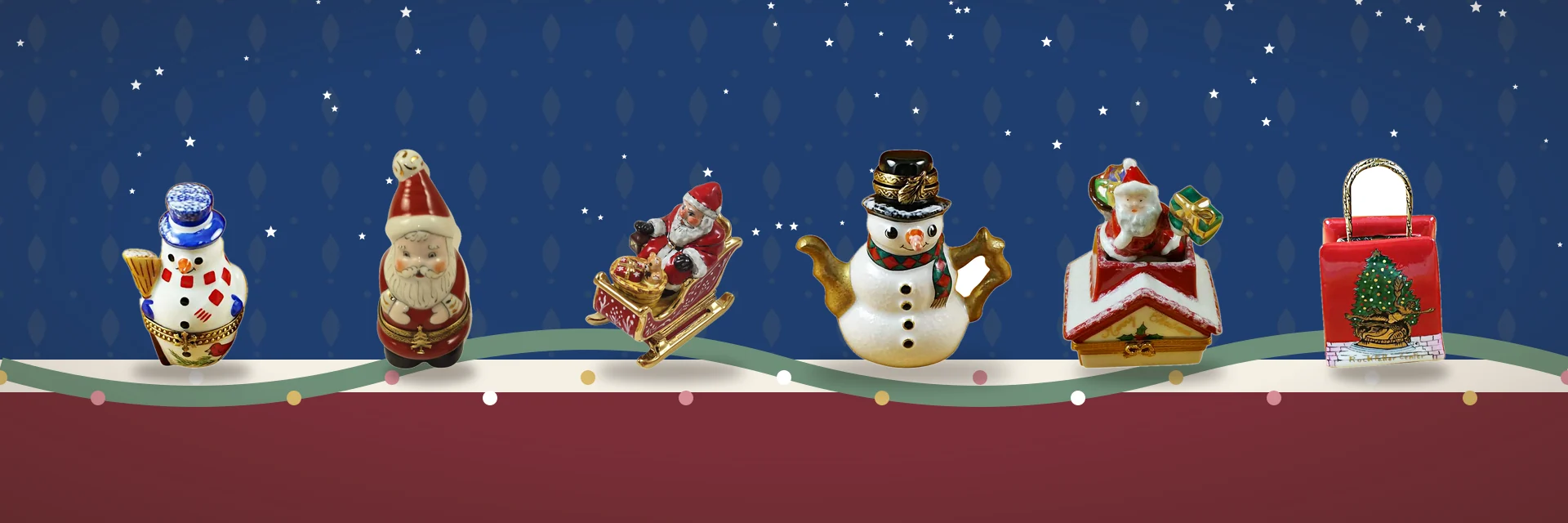
Santa, snowmen, Christmas trees, ornaments, Easter eggs and bunnies, pumpkins, turkeys, hearts and more. Holiday boxes are a whole collecting world of their own; see Holiday Boxes for a full guide.
Nature
Flowers, shells, butterflies, ladybugs, bees, birds’ nests, mushrooms and leaves. Nature boxes overlap with the classic style, since a plain oval covered in violets is also a “nature” box, but here the flower or shell is the shape itself.
Good to know: Themes overlap freely. A cat sitting in a teacup is both “animal” and “food.” When you record a collection, pick one main theme per box so your list stays sortable. See Collecting for record-keeping ideas.
The “surprise inside” tradition
Open many modern figural Limoges boxes and you will find something extra inside: a tiny porcelain charm loose in the base, or a little scene painted on the inside of the lid or floor. A piano box might hold a miniature sheet of music; a fishing basket might hold a fish; a baby carriage might hold a rattle.
The surprise is part of the fun of giving a Limoges box, because the recipient discovers it only when they open the lid. Rochard, a Limoges box company active since the 1970s, says it was the first to introduce surprises inside Limoges boxes; whoever started it, the idea is now common across many makers.
There are three common kinds of surprise:
- A loose charm: a separate miniature, usually under half an inch, resting inside. Easy to lose, so check for it before you wrap the box or put it away.
- A painted interior: a small motif or message painted inside the lid or base. It cannot fall out, which makes it ideal for children’s gifts.
- A molded interior detail: a shape formed as part of the base itself.
Not every box has a surprise, and older or classic boxes usually don’t. A missing charm also slightly affects how complete a box is when it is resold, so keep charms with their boxes. For more on condition and completeness, see What’s It Worth?.
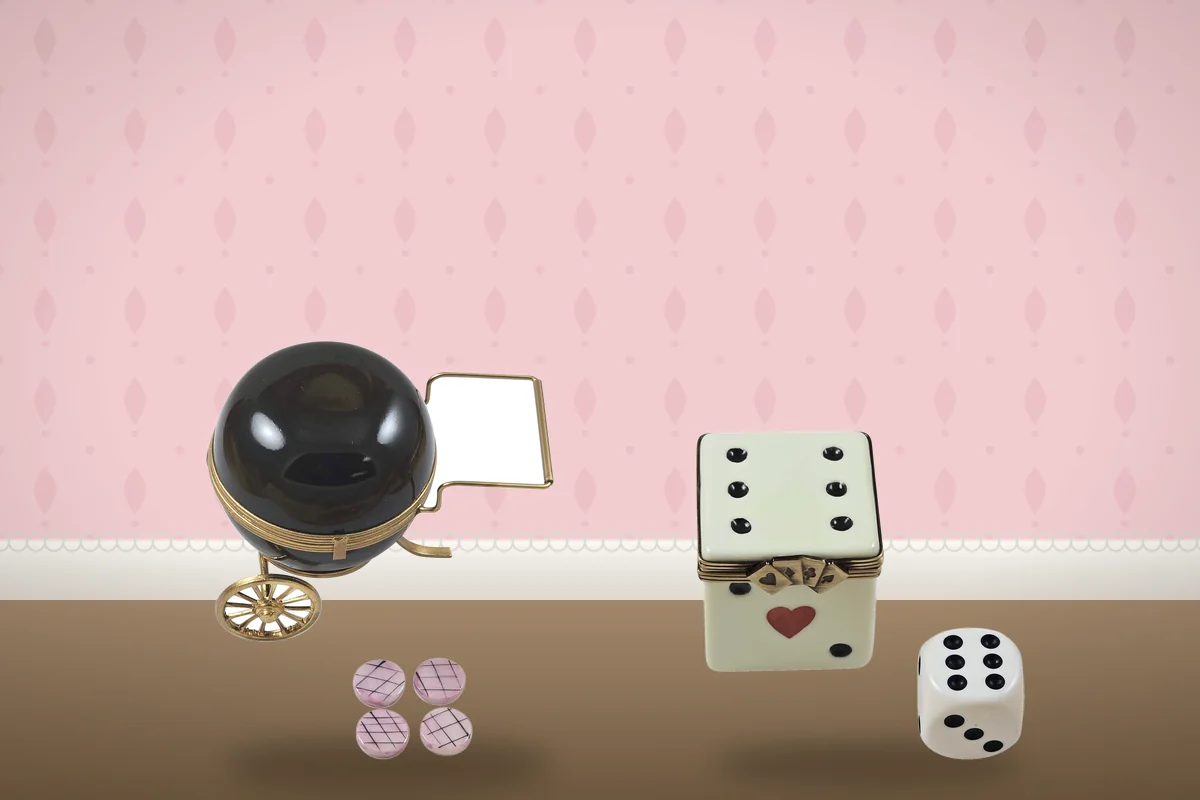
Tip: If you give a box with a loose charm, tell the recipient (or slip a note in the card) so it doesn’t get shaken out and thrown away with the tissue paper.
Sizes
Limoges boxes are small. Most fall somewhere between about 1 and 3 inches across, and many popular figurals are around 2 inches. Pill boxes and tiny charms can be well under an inch and a half, while elaborate pieces, such as carousels, large houses or musical instruments, can be 4 inches or more.
Online photos are usually close-ups, which makes boxes look bigger than they are. Always check the stated dimensions, and picture them against something familiar: a US quarter is just under an inch across, and a golf ball is about 1.7 inches.
Size affects:
- Use: a ring fits in most boxes; a folded note needs a flatter, wider one.
- Detail: larger boxes give painters more room, so they often show more intricate work.
- Price: larger, more complex molds generally cost more, though painting quality and maker matter just as much.
Lids, hinges and clasps
A Limoges box is two pieces of porcelain, a base and a lid, joined by a metal mount. The metal is fitted by hand after firing, and it is one of the things that separates a well-made box from a poor one.
The hinge
The hinge runs along the back. It should open smoothly, without grinding, and the lid should line up neatly with the base when closed, with no gap and no wobble. The metal band should be glued evenly with no excess adhesive visible.
The clasp
The clasp is the little catch at the front. Many are simple hooks or tabs. On figural boxes, though, the clasp is often a tiny decorative piece that matches the theme: a bee, a ladybug, a bow, a heart, a bone on a dog box, a key on a house. These themed clasps add character and are a sign of thoughtful design.
Metal
Mounts are typically brass, often gilt-toned. Some makers use silver-tone metal for certain designs. Brass will look its best with only a soft dry cloth; see Care & Display for cleaning advice.
Lid styles
- Hinged lid: the standard. Opens on a hinge and closes with a clasp.
- Lift-off lid: found on some older and some very small boxes, with no hardware at all.
- Side-opening or split figurals: some figures open across the middle or at an angle, so the opening follows a natural line in the design, such as the rim of a basket.
Tip: Never force a stiff clasp. Press gently on the lid above the catch while easing it open. Forcing it can bend the metal or chip the porcelain edge.
Painted vs. molded detail
The shape of a figural box comes from the mold. Ears, folds, petals and textures are formed in the porcelain before it is fired. The painter then adds color, shading, outlines and fine details by hand.
When you look closely, you can judge how much work went into each:
- Molded detail gives depth: the raised petals of a rose, the curl of a cat’s tail, the keys of a piano.
- Painted detail gives life: the shading in fur, a glint in an eye, a tiny label on a wine bottle, the pattern on a scarf.
The best boxes combine both. A crisp mold with careless painting looks flat; beautiful painting on a soft, blurry mold loses its edges. Under a magnifier, hand-painting shows slight variations in line and brushstroke, while decals (printed transfers) show uniform dots or perfectly identical patterns. Our Is It Real? guide explains these checks in more detail.
The French phrase peint main means “hand painted,” and it often appears on the base of genuine boxes. See Reading the Marks for what the other words and initials mean.
Special finishes
Beyond ordinary enamel colors, some boxes use finishes that change their look and, often, their price.
Gilt and gold accents
Many boxes have gold trim, gold bands or gold highlights. This is typically a gold preparation applied by hand and fired on in a separate, lower-temperature firing, so it adds steps (and cost). Gilt edges show wear first, so look at rims and high points when buying older pieces.
Pearl and lustre finishes
Some boxes have a soft, iridescent sheen, often described as pearl or lustre. It catches the light and suits wedding, baby and seashell designs. Like gold, these finishes sit on the surface and should be cleaned gently.
Cobalt and other deep grounds
A “ground” is the background color covering the porcelain. Deep cobalt blue is the classic, often paired with gold patterns or a white panel painted with flowers. Limoges is closely associated with a deep cobalt called bleu de four (French for “kiln blue”), traditionally fired at high temperature. Other rich grounds include deep green, burgundy and black.
White and minimal
At the other end of the scale are mostly white boxes with a single painted motif or a gold line. They show off the bright, translucent quality of the porcelain and suit modern interiors.
Limited editions and signed pieces
Some designs are made in deliberately small runs. A limited edition box may carry a number (for example “45/500”) on the base, along with the maker’s mark. Others are “retired” when a maker stops producing them, which is different from a numbered limited edition but can also make them harder to find later.
Many genuine boxes also carry the painter’s initials or a small signature, because each piece is hand-painted. This is normal for the genre and doesn’t on its own make a box rare. What makes signed pieces special is when a known artist painted something unusual, or when a piece was painted as a one-off commission.
What to keep with a limited edition box:
- The original box or packaging.
- Any certificate or card that came with it.
- Notes on where and when you bought it.
These don’t guarantee value, but they help document the piece. If you need a formal valuation, use a certified appraiser.
How to choose
Say you are buying for your sister, who loves her garden and her two terriers. You could go classic (an oval painted with her favorite flower) or figural (a terrier in a flower pot). A good way to decide:
- Start with the person, not the box. What do they love, do or remember? That gives you a theme.
- Pick a family. Classic shapes feel elegant and timeless; figurals feel personal and playful.
- Check the size against something familiar, and decide whether it needs to hold anything.
- Look closely at the painting and the fit of the hinge and lid.
- Ask about a surprise inside. It is a nice bonus, especially for children.
- Consider what they already own. A box that matches an existing collection gets displayed; one that doesn’t may live in a drawer.
- Think about finishes. Gold and cobalt read as formal; pastels read as soft and sentimental.
For occasion-by-occasion ideas, see Gift Ideas. If you’re ready to buy, LimogesBoutique.com carries a wide range of hand-painted Limoges boxes in both classic and figural styles.
FAQ
Are figural boxes “less traditional” than classic shapes? Classic shapes have the longer history, but figurals have been part of the Limoges tradition for decades and are now among the most popular styles. Neither is more “genuine” than the other; quality depends on the porcelain, the painting and the fitting.
Does every Limoges box have a surprise inside? No. Surprises are common on modern figural boxes but far from universal, and older and classic boxes usually don’t have them.
What is the most popular shape? There is no official count, but hearts, ovals, animals and holiday designs are among the most widely made and gifted.
Can I actually use a Limoges box? Yes, gently. Rings, earrings, pills, a lock of hair or a folded note are all fine. Avoid anything heavy, sharp or damp.
Are limited editions worth more? Sometimes, but not automatically. Condition, maker, design, demand and documentation all matter. Values vary widely, so consult a certified appraiser for a formal valuation.
Why does the same design look slightly different from box to box? Because each one is painted by hand. Small variations in color and line are expected and are a sign of handwork, not a defect.
Keep reading
 Gift IdeasLimoges box gift ideas by occasion: weddings, anniversaries, babies, birthdays, retirement, men and collectors, plus…
 Holiday BoxesChristmas and holiday Limoges boxes explained: Santa, nutcrackers, ornaments, Hanukkah, Easter and more, plus dated…
 CollectingHow to start and grow a Limoges box collection: choosing a theme, where to buy and how to vet sellers, mistakes to…