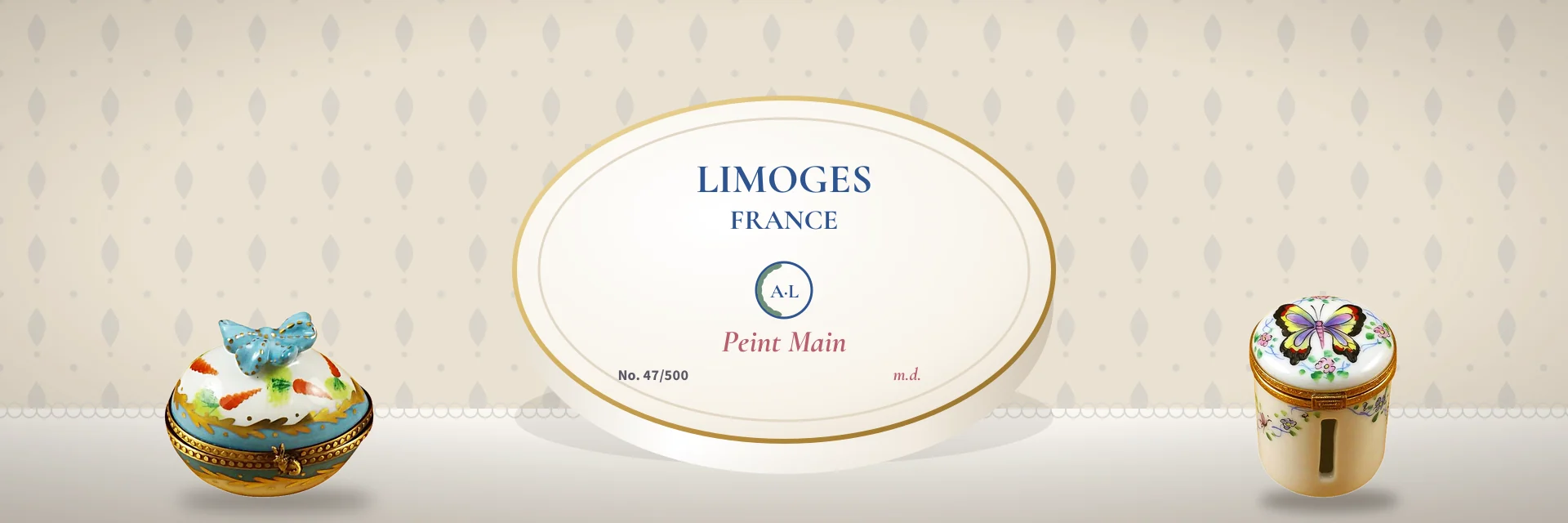
Limoges Box Guide · Reading the Marks
Reading the Marks on a Limoges Box
The base of a Limoges box is a small, crowded label. Here's how to read every word, initial and number on it, and how to look up a mark you don't recognize.
Turn a Limoges box over and you’ll usually find a cluster of painted or stamped words, initials and symbols. To a newcomer it looks like a jumble. To a collector it’s a short biography of the box: where it was made, how it was decorated, which workshop or company stands behind it, who painted it, and sometimes how many were made.
On this page
- Where to look
- The layers of a mark
- "Limoges France"
- Decoration wording: Peint Main and its cousins
- Workshop, design house and importer marks
- Painter's initials
- Limited editions and numbering
- Other words you might see
- Underglaze vs. overglaze marks
- Older and antique stamps
- Common mark wordings at a glance
- How to photograph a mark
- How to look up a mark
- FAQ
This page decodes those marks one by one. It’s a reading guide, not an authenticity test. If your main worry is whether a box is genuine at all, start with Is It Real?, which explains why marks are only one clue and how to check the painting, porcelain and hinge. Then come back here to make sense of the details.
Where to look
Most marks sit on the underside of the base. But not all of them, and beginners often miss half the information.
- Underside of the base: the main location for “Limoges France,” decoration wording, workshop and importer names, and painter’s initials.
- Inside the lid: some boxes put the painter’s initials, a limited-edition number, a date, a message or the importer’s name here, especially when the base is small or sculpted.
- Inside the base: less common, but you may find a painted motif, a year or initials on the floor of the box.
- Side or rim: rare on boxes, though very small pieces sometimes squeeze a mark onto a flat area near the hinge.
- On the surprise: a tiny porcelain charm inside the box is usually unmarked, but check anyway.
Use a bright light and a magnifier. Marks on modern boxes are often painted in fine script only a few millimeters tall, and gold marks can disappear under a glare.
The layers of a mark
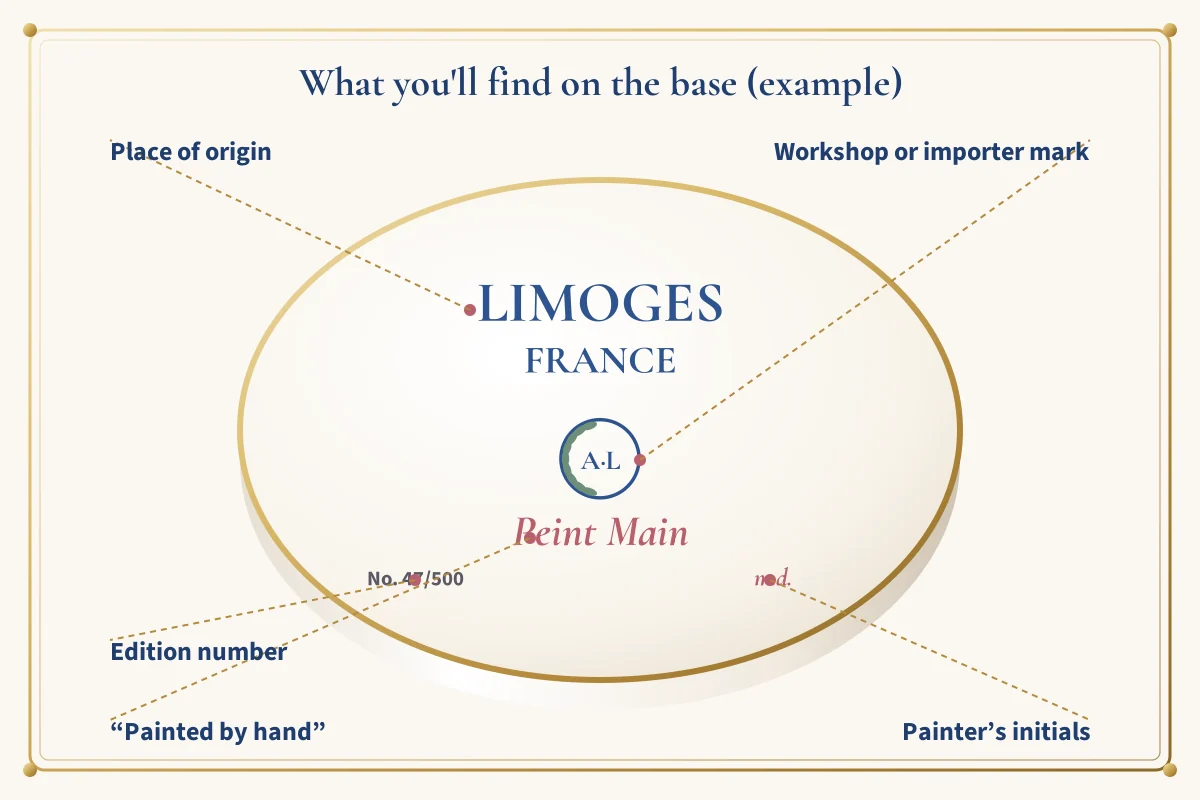
Think of a typical modern base as several marks stacked together, each answering a different question.
| Question | Typical mark |
|---|---|
| Where was it made? | “Limoges France” |
| How was it decorated? | “Peint Main,” “Peint à la main,” “Rehaussé Main,” etc. |
| Which company is behind it? | A workshop, design house or importer name or logo |
| Who painted it? | Painter’s initials or a short signature |
| How many exist? | An edition number such as “45/500” or the words “Édition Limitée” |
| Anything else? | Mold or model numbers, a year, “Déposé,” a retailer’s name |
Not every box has every layer. A simple older box may have one line; a modern limited edition may have six.
“Limoges France”
This is the place-of-origin line. “Limoges” names the city in central France that, with its surrounding Haute-Vienne department, has been a center of hard-paste porcelain since the first pieces were made there in 1771. “France” names the country.
On modern boxes, “Limoges France” is usually painted or stamped in one line, sometimes curved around a logo. On its own, it tells you the box claims French Limoges origin. It does not tell you the maker, the decoration method or the age.
A few related forms you may see:
- “Limoges” alone, without “France.” Common on older pieces and on some foreign goods; read it together with the other marks.
- “Fabriqué en France” or “Made in France,” sometimes added beside or instead of “France.”
- “Porcelaine de Limoges,” meaning “Limoges porcelain.”
- “Castel Limoges,” “Artoria Limoges” and similar, where the city and a company name are combined.
Good to know: Since 2017, “Porcelaine de Limoges” has been a protected geographical indication in France, and in 2026 it gained EU-level registration. Certified producers may use an official logo, but many genuine boxes, especially older ones, predate the scheme and carry no such logo. Its absence is normal.
Decoration wording: Peint Main and its cousins
The second key line describes how the box was decorated. These are French phrases, and small differences matter.
Peint Main / Peint à la main
Both mean “painted by hand” (peint = painted, main = hand). This is the wording collectors look for: it states that the decoration was applied with a brush rather than printed. On most modern collectible boxes, this phrase sits directly below “Limoges France.”
Rehaussé Main
“Enhanced by hand” or “highlighted by hand” (rehaussé = raised up, heightened). On porcelain this generally indicates a printed transfer (a ceramic decal) with hand-applied touches, often gold or raised accents, added on top. These boxes are genuine Limoges porcelain but not fully hand-painted, and are typically less expensive than Peint Main pieces.
Décor Main
“Hand decoration.” This wording is less precise. Depending on the workshop, it can mean full hand painting or partial hand decoration. Look closely at the painting itself to decide.
Fait Main / Entièrement Fait Main
“Made by hand” and “entirely made by hand.” These describe the making of the box overall, not just the painting. You’ll occasionally see them on smaller workshops’ pieces.
No decoration wording at all
Common on older and antique pieces. Before the modern collectible-box era, many Limoges pieces carried only a factory stamp. It’s also seen on boxes decorated with transfers. A missing phrase isn’t proof of anything; it simply means the base can’t answer this question for you, and your eyes and loupe have to.
Workshop, design house and importer marks
The most distinctive part of many bases is a company name or logo. This is also the most confusing, because the name on the base isn’t always the porcelain factory.
The modern Limoges box world includes several kinds of businesses:
- Porcelain manufacturers that cast and fire the white porcelain (called “whiteware” or “blanks”).
- Decorating workshops (ateliers) that paint and finish the boxes.
- Design houses and importers, often based in the US, that create or commission designs, have them made and decorated in Limoges, and sell them under their own name.
Some companies do all three; others do only one. So a base might show a decorating workshop’s mark, an importer’s name, or both. Well-known names you’ll see on bases include Rochard, Artoria, Chamart and PV (Parry Vieille), among many others. Each has its own logo style, and our makers page explains who they are and what each kind of company does.
Tip: Two boxes from the same mold can carry different company marks if two firms sourced the same whiteware. Don’t assume a shape belongs to one maker just because you’ve seen it before.
Retailer and exclusive marks
Some boxes were made as exclusives for a particular store, museum shop or organization, and the base may name that retailer alongside the maker. These marks are helpful for dating and can add interest for collectors who focus on a theme or a store’s series.
Painter’s initials
Many modern workshops ask each painter to sign the box, usually with two or three initials, sometimes a short name. These are typically painted on the base near the other marks, though some appear inside the lid.
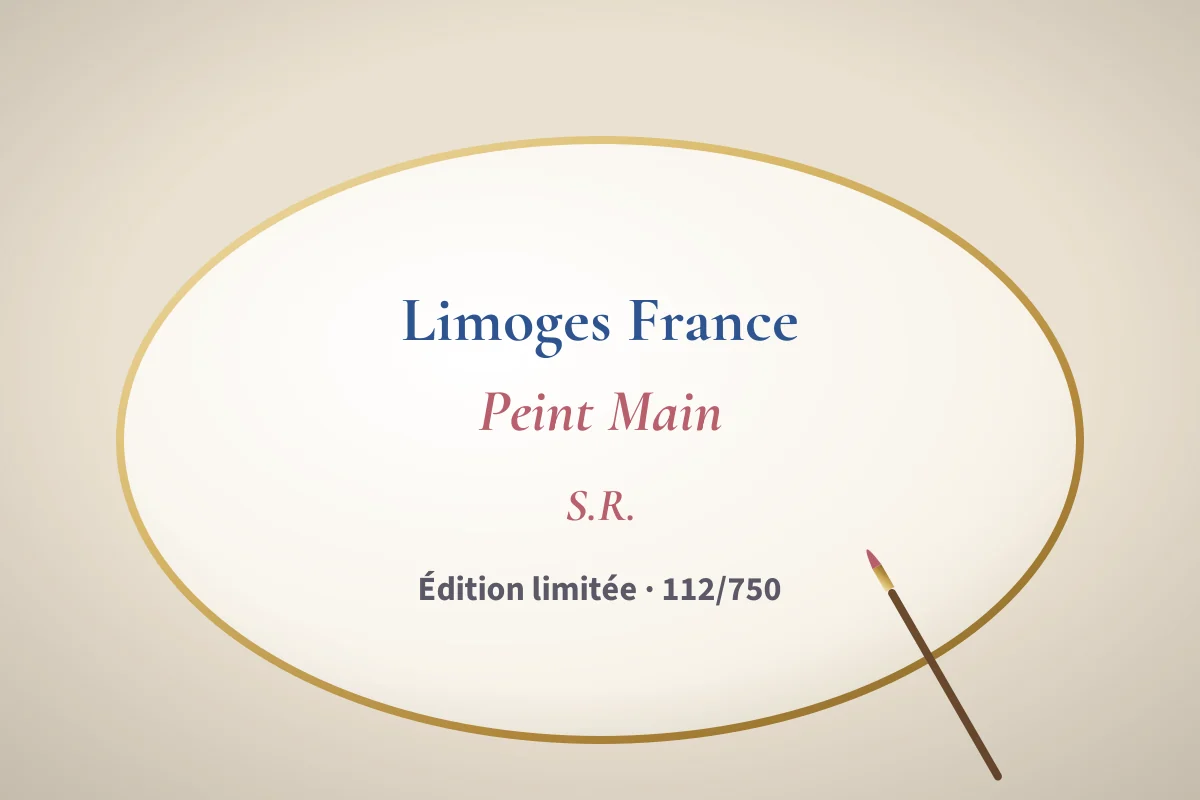
What initials tell you:
- That a specific person painted it. Collectors enjoy this personal link, and some seek out favorite painters.
- That two “identical” boxes aren’t. The same design painted by two artists will show different initials and slightly different handwork.
- Nothing about the painter’s identity on their own. Painters are rarely listed publicly, so initials usually can’t be looked up. Some importers can tell you which artist they belong to; most collectors simply record them.
Look at initials under magnification. Hand-painted initials show the same brush texture as the decoration. If they look printed, the decoration may be printed too.
Limited editions and numbering
Limited-edition boxes are usually marked with a number and an edition size, written as a fraction:
- “45/500” means box number 45 in an edition of 500.
- “No. 45” alone means the box is numbered, but the edition size may be stated elsewhere (or not at all).
- “Édition Limitée” or “Limited Edition” confirms the intent. Édition limitée is simply French for limited edition.
- “Pièce unique” means “one of a kind.”
- A year (such as a dated Christmas box) can signal an annual design that was made only for that season.
Where the number appears varies: often on the base, sometimes inside the lid. A numbered box may come with a certificate from the importer; keep it with the box, as it helps with insurance and resale. Low numbers aren’t automatically more valuable, though some collectors like them. What matters more for value is the edition size, the design and condition, as our value guide explains.
Mold and model numbers
Some bases carry a short number or code that has nothing to do with editions. These are often mold, model or design references used by the workshop or importer. They can help you match a box to a catalog or a dealer’s records, but they’re rarely decoded publicly.
Other words you might see
- Déposé: “registered.” It indicates the design or mark was registered (filed) by the company. It’s common on French goods of many kinds and doesn’t by itself date a piece.
- Modèle déposé: “registered design.”
- Fait à Limoges: “made in Limoges.”
- Artiste / Signé: “artist” / “signed,” sometimes added before a name.
- A small symbol (a bird, star, crown, leaf or butterfly) that’s part of a company’s logo.
Underglaze vs. overglaze marks
This distinction is especially useful on older Limoges porcelain, and it explains why some pieces carry two quite different marks.
Underglaze marks are applied to the porcelain before the glaze and are fired at the same high temperature as the glaze, around 1,400°C. They end up sealed inside the glassy surface. They’re smooth to the touch, can’t be scratched off, and often look slightly soft-edged. On 19th- and early-20th-century Limoges porcelain, the factory that made the white blank commonly used an underglaze mark, very often in green.
Overglaze marks are applied on top of the fired glaze and fused on in a lower-temperature decorating firing (roughly 750 to 950°C for overglaze colors in general). They often sit very slightly raised, may show a fine texture or sheen under a loupe, and can wear with long handling. Decorating studios, whether the factory’s own or an independent decorator, typically used overglaze marks, in red, gold, blue, brown or other colors.
How to tell them apart:
- Tilt the base under a light. An overglaze mark often catches the light differently from the surrounding glaze.
- Run a fingertip gently across it. Overglaze marks may feel faintly raised; underglaze marks feel like part of the glass.
- Look for wear. Rubbing or partial loss suggests overglaze.
Why it matters: a piece with only an underglaze factory mark was usually sold as plain white porcelain and decorated somewhere else, sometimes by an amateur china painter. A piece with both generally means a factory blank decorated by a professional studio. That changes how you identify and value it. Haviland, for example, used separate whiteware and decorating marks for much of its history, and collector references catalog both.
Modern boxes usually have overglaze marks painted at the decorating stage, since that’s when the painter adds the brand, wording and initials.
Older and antique stamps
If your box looks old, the marks may follow different conventions:
- A single factory stamp with no “Peint Main” wording, sometimes just “Limoges” and a symbol or initials.
- No country name. In 1890 the US passed the McKinley Tariff Act, which, from 1891, required imported goods to be marked with their country of origin. Earlier pieces often lack “France”; later ones generally include it. Marking practices weren’t perfectly uniform, so treat this as a rough guide, not a date.
- “Made in France.” Wording that includes “Made in” is generally associated with later export pieces, though exact start dates vary.
- A decorator’s mark added on top of a factory’s, as described above.
- Hand-painted signatures on the decoration itself, such as an artist’s name in a corner of the painted scene, which was common on fine 19th-century pieces.
Many historic Limoges factory marks are cataloged in collector reference books; Mary Frank Gaston’s Collector’s Encyclopedia of Limoges Porcelain is a widely used one. Be aware that some old marks have been revived or copied, so a mark alone doesn’t prove age. Style, body, wear and the hinge all need to agree. Our history page gives the wider timeline.
Common mark wordings at a glance
| Wording on the box | What it means | What it tells you |
|---|---|---|
| Limoges France | Made in Limoges, France | Claimed place of origin |
| Limoges (alone) | Limoges | Origin claim; common on older pieces; check other clues |
| Porcelaine de Limoges | Limoges porcelain | Origin claim; may appear with the official IG logo |
| Peint Main | Painted by hand | Fully hand-painted decoration |
| Peint à la main | Painted by hand | Same as Peint Main |
| Rehaussé Main | Enhanced by hand | Printed transfer with hand touches |
| Décor Main | Hand decoration | Some or all decoration by hand; inspect closely |
| Fait Main | Made by hand | Handmade overall |
| Entièrement Fait Main | Entirely made by hand | Handmade at every stage |
| Fabriqué en France | Made in France | Country of origin |
| Édition Limitée | Limited edition | Made in a set number |
| 45/500 | Number 45 of 500 | Edition number and size |
| Pièce unique | One of a kind | Unique piece |
| Déposé / Modèle déposé | Registered / registered design | Design or mark was registered |
| Two or three initials | Painter’s initials | The individual artist |
| Company name or logo | Workshop, design house or importer | Who made, decorated or sold it |
How to photograph a mark
A clear photo is what any dealer, appraiser or online forum will ask for. Here’s how to take one that’s actually useful.
- Use soft daylight. Stand near a window but out of direct sun. Overhead lamps cause glare on glaze and gold.
- Hold the box steady. Rest it upside down on a folded towel so it can’t roll or scratch.
- Shoot straight on. Hold the phone parallel to the base to avoid distortion.
- Get close, then crop. Use your phone’s macro or 2x lens, tap to focus on the mark, and crop afterward rather than zooming digitally.
- Kill the glare. If gold or glaze reflects, tilt the box a few degrees or hold a sheet of white paper to one side as a diffuser.
- Take a set. Photograph the base, the inside of the lid, the hinge, the clasp and each side. Add one shot with a ruler or coin for scale.
- Write it down. Copy every word, number and initial exactly as written, including accents and line breaks.
How to look up a mark
Once you have photos and a written transcription:
- Start with the wording. Use the table above to decode the French phrases.
- Identify the company. Search the company name or logo description. For modern boxes, our makers page is a good starting point.
- Check reference books for antique factory and decorator marks.
- Ask a specialist dealer. Many modern boxes can be identified from photos by someone who handles them daily.
- Visit a museum. If you’re traveling, the Musée national Adrien Dubouché in Limoges holds a major ceramics collection; see Visiting Limoges.
- Record what you find. Add the marks, photos and any history to your collection notes, as our collecting guide suggests.
Worked example
Say the base of your heart-shaped box reads, on three lines: “Limoges France,” “Peint Main,” and a company logo, with “MD” in small script below and “112/750” inside the lid.
Decoded: claimed French Limoges origin; fully hand-painted; made or sold by the company in the logo; painted by an artist with the initials MD; number 112 in an edition of 750. Next step: confirm the company, then check the painting and hinge as described in Is It Real?.
FAQ
My box has no marks at all. Is it worthless?
Not necessarily. Very old pieces, some one-off studio boxes and some boxes whose marks have worn away can lack marks. But unmarked boxes are harder to identify and are usually valued more cautiously. Rely on the painting, porcelain and mount.
Why do some boxes have two company names?
Usually because one company made or decorated the box and another (an importer, design house or retailer) sold it. Both can appear on the base.
Can I tell the age from the marks?
Only roughly. Country-of-origin wording, decoration phrases and company logos can narrow a range, especially when combined with style. For anything important, ask an appraiser.
Is “Peint Main” more valuable than “Rehaussé Main”?
Generally yes, because full hand painting takes much longer. But condition, design and maker matter too.
The initials on my box are hard to read. Does it matter?
Not much for identification. Record them as best you can; they’re mainly of personal and collector interest.
If you’re ready to buy a box whose marks are clearly shown and explained, the team behind this guide runs LimogesBoutique.com.
Keep reading
 Is It Real?Is your Limoges box genuine? Use our hands-on checks for marks, brushwork, hinges, porcelain and price, plus real…
 The MakersWho makes Limoges boxes? Profiles of Artoria, Rochard, Chamart, PV, Arquié and others, plus how to research an…
 Glossary & FAQAn A–Z glossary of Limoges box terms, from atelier and bisque to Peint Main and the IGP Porcelaine de Limoges, plus…