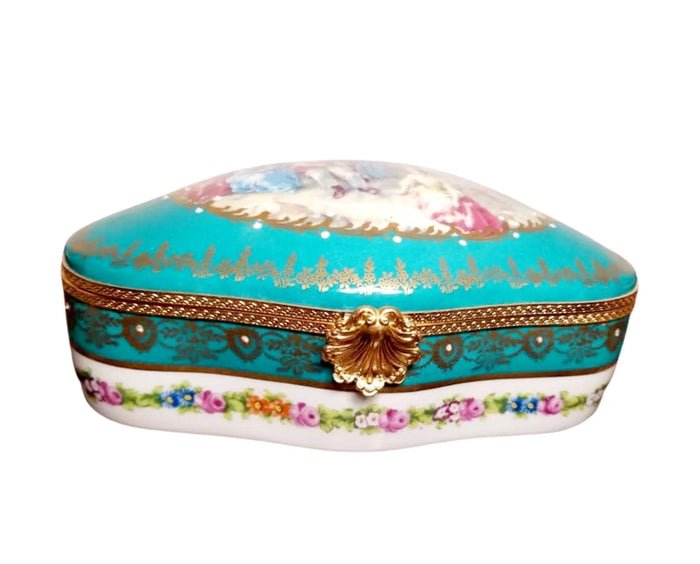
The word “Limoges” sells, which is why it appears on so many boxes that never went near France. The good news is that look-alikes tend to give themselves away. None of the signs below proves a box is fake on its own, but two or three together should make you cautious. For the full step-by-step method, see How to Tell If a Limoges Box Is Real.
Warning signs on the base
1. “Limoges” without “France”
Genuine French boxes almost always say “Limoges France” or “Limoges” with “France” nearby. “Limoges” on its own, especially in a plain modern font, is a common look-alike mark. Read every word on the base, not just the first one.
2. A paper sticker instead of a fired mark
Real marks are fired into or onto the porcelain, so they can’t be peeled off. A gold foil sticker reading “Limoges” tells you almost nothing. Look underneath it, and around it, for marks that are part of the porcelain itself.
3. Traces of a removed label
Sticky residue or a clean rectangle on the base can mean a “Made in China” or “Made in Taiwan” label was taken off. That doesn’t mean the box is worthless, but it does mean it isn’t French Limoges.
4. The words “style”, “type” or “inspired”
In listings and on tags, “Limoges style” almost always means “not from Limoges”. Sellers of genuine boxes name the maker and the marks instead.
Warning signs in the painting
5. A dot pattern under magnification
Under a 10x loupe, printed decoration shows tiny regular dots or an even screen pattern. Hand painting shows brushstrokes, slight changes in thickness and colors blending into each other. A box marked “Peint Main” (hand painted) should show real brushwork.
6. Painting that stops at the edges
On a hand-painted figural box, the decoration usually wraps naturally around curves, ears, tails and folds. Decals often look flat, stretched or wrinkled where they meet a curve, and may stop abruptly at a seam.
7. Gold that looks like paint, not metal
Fired gold on Limoges porcelain has a soft, metallic glow. Bright yellow paint, glitter or gold that flakes like nail polish is a sign of a cheaper decoration process.
Warning signs in the metalwork
8. A sloppy or plastic hinge
Genuine boxes have a fitted metal mount, usually brass, with a neat hinge. Plastic hinges, visible gaps, crooked mounts or thick globs of glue suggest a mass-market look-alike, or a poor repair.
9. A magnetic closure
Traditional Limoges boxes close with a small metal clasp. Magnetic closures are typical of inexpensive look-alikes. A magnet alone isn’t proof, but it’s a reason to check everything else carefully.
10. A lid that doesn’t line up
A well-made box closes cleanly with the lid sitting square on the base. A lid that rocks, overhangs or has to be forced suggests poor workmanship, or a mount that has come loose.
Warning signs in the listing or the price
11. No photo of the base
Any seller of a genuine Limoges box can photograph the marks. If a listing shows only the top, ask for the base. If the seller won’t provide it, walk away.
12. A price that seems too good to be true
Hand-painted French boxes take many hours of skilled work. A brand-new “hand-painted Limoges” box for a few dollars is almost certainly neither. Secondhand bargains do happen, but a very low price combined with any of the signs above is a strong warning.
What to do if you suspect a fake
Compare the marks with our guide to reading the marks and look up the maker in The Makers Behind Limoges Boxes. If you bought online and the box isn’t as described, contact the seller and the marketplace quickly, because buyer protection usually has a time limit. If you inherited it, enjoy it for what it is: plenty of look-alikes are charming, just not French.
Quick answers
Usually not. Many genuine boxes have one oddity, such as worn marks or a replaced clasp. Two or three warning signs together are a much stronger signal.
A 10x jeweler’s loupe and good daylight. Together they show you the difference between brushstrokes and printed dots, and they make faint marks on the base readable.
Usually only a little, unless they’re well made or have sentimental value. They’re priced as decorative trinket boxes rather than as French Limoges porcelain.
This article is general guidance from the team behind LimogesBoutique.com, who have worked with Limoges boxes for more than thirty years. It is not a formal appraisal. For more help, see our Limoges box Q&A.
Leave a Reply