Limoges Box Guide · Glossary & FAQ
Limoges Box Glossary & Frequently Asked Questions
Plain-English definitions of the French and technical words you'll meet on bases, price tags and auction listings, followed by quick answers to the questions we hear most often.
Limoges boxes come with their own vocabulary, part French, part ceramics jargon, part collector shorthand. A listing that says “Peint Main, retired, with surprise, rehaussé main mounts” can be baffling if you’re new. This page translates all of it.
The first half is an A–Z glossary of more than 40 terms. The second half is a long FAQ, with links to the pages on this site where each subject is covered in depth.
A–Z glossary
A
Atelier French for “workshop” or “studio.” In the Limoges box world it usually means the decorating workshop where white porcelain blanks are painted, gilded and fitted with their metal mounts. Many boxes are shaped by one company and decorated by another atelier.
Authorized dealer A retailer that buys directly from a maker or its official distributor and is recognized by that maker. Buying from one gives you more confidence about authenticity than an anonymous online listing.
B
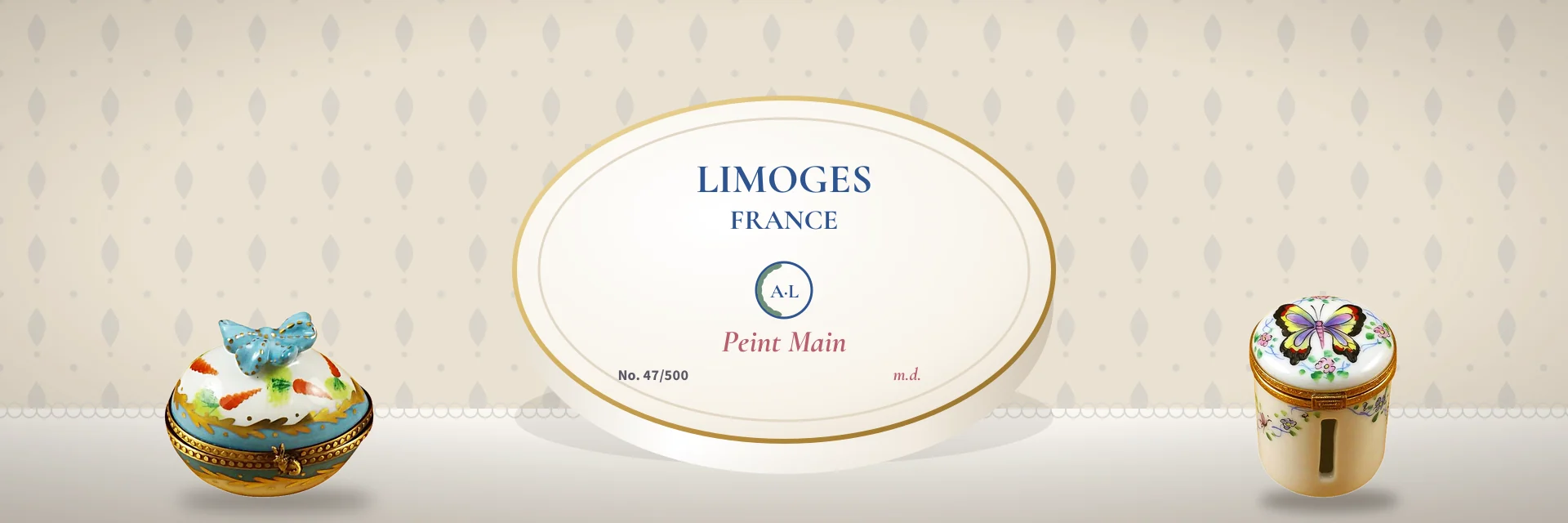
Base mark (backstamp) The marks on the underside of a box: usually “Limoges France,” often “Peint Main,” and sometimes a maker’s logo and a painter’s initials. Our page on Reading the Marks explains how to interpret them.
Biscuit Porcelain that has been fired but not glazed. True high-fired biscuit is matte, slightly velvety to the touch and very white; it is often used for figurines. On a box, any unglazed area (such as the rim where lid and base meet) gives you a glimpse of the biscuit body.
Bisque The English term most people use for the same idea: fired, unglazed ceramic. You’ll also hear “bisque firing” for the first, lower-temperature firing that hardens a piece before it is glazed.
Blank (blanc) A finished white glazed porcelain piece that has not yet been decorated. Decorating ateliers buy or receive blanks, then paint them.
Bleu de four “Kiln blue,” a deep cobalt blue fired at very high temperature that is a traditional Limoges specialty. It is often paired with gold.
Bonbonnière French for a small sweets or candy box. Some round or oval Limoges boxes are sold under this name.
C
Casting (coulage) Pouring liquid porcelain (slip) into a plaster mold. The plaster absorbs water, a layer of clay firms against the walls, and the excess is poured out. Most figural boxes are cast.
Clasp (fermoir) The small metal catch at the front of a box that holds the lid closed. On many Limoges boxes it is a tiny sculpted shape (a flower, a bow, a ladybug) that relates to the design.
Cobalt A metal oxide that gives porcelain its classic deep blue. Because it survives the highest kiln temperatures, it can be used under the glaze as well as over it.
Collection piece / series A box designed as part of a themed set, such as a holiday series or a set of famous landmarks. Series pieces are often more desirable when collected together.
D
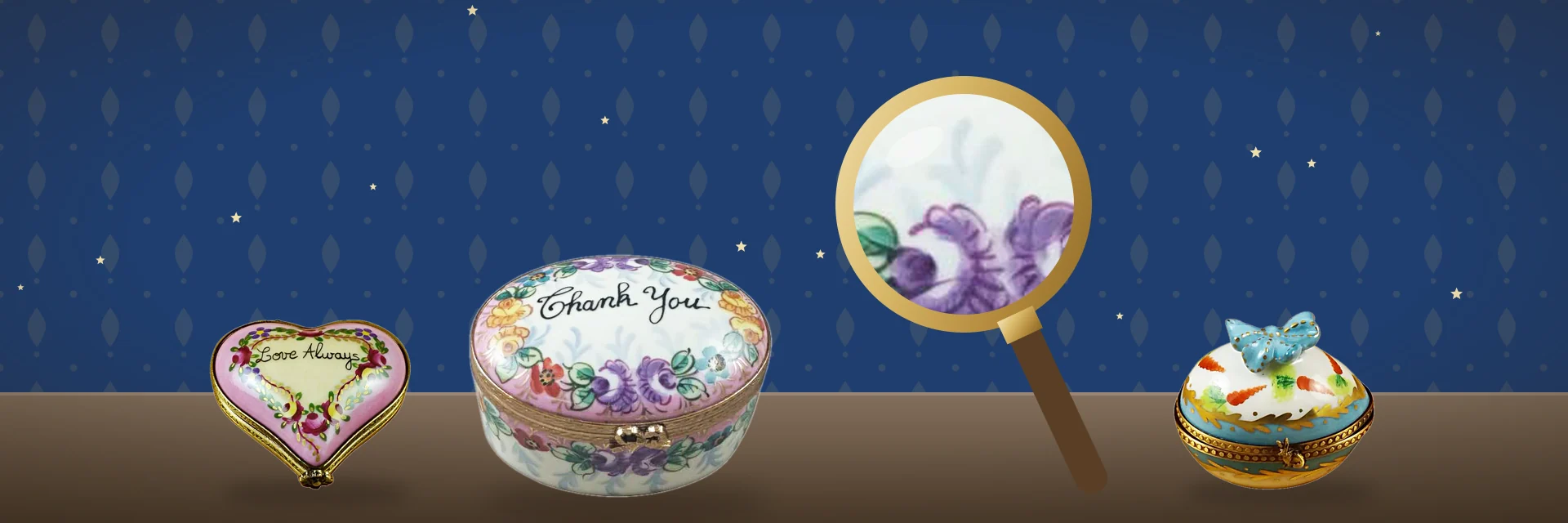
Decal (transfer, chromo) A printed image transferred onto porcelain and then fired. Decals are a legitimate decoration method, but a box decorated only by decal is not “hand painted.” Look for repeating dots under a magnifier; our Is It Real? page shows how.
Décor French for the decoration or design on a piece: painted motifs, gilding, borders and inscriptions together.
Déposé French for “registered.” When you see it on a mark, it means the design or trademark was legally registered.
E
Émail / émaux This word confuses everyone. In French ceramics, émail (plural émaux) means glaze, and the term is also used for the vitrifiable colors painters apply. Separately, “Limoges enamel” means a centuries-old craft of glass fused onto copper. Limoges boxes are porcelain, not enamel on copper.
F
Feldspar A mineral that melts during firing and helps bind porcelain into a glassy, non-porous body. Limoges porcelain paste is traditionally a mix of kaolin, quartz and feldspar.
Fettling Cleaning up a molded piece by hand before firing: trimming away seam lines from the mold, smoothing edges and sponging the surface. Careful fettling is one sign of quality.
Figural box A box shaped like an object, animal or figure (a teapot, a cat, a carousel horse) rather than a simple round, oval or square. See Shapes & Styles.
Firing Heating porcelain in a kiln. Limoges porcelain typically goes through a first firing at roughly 980°C, a glaze firing at about 1,400°C, and one or more lower decoration firings to fix the paint and gold.
G
Gilding (dorure) Applying gold, usually as a liquid gold preparation, then firing it so it bonds to the glaze. Good gilding is even and bright, with clean edges along borders and mounts.
Glaze The glassy coating fused onto porcelain at high temperature. It makes the surface smooth, shiny and waterproof, and provides the surface painters work on.
Grand feu / petit feu “Great fire” and “small fire.” Grand feu refers to the highest firing (around 1,400°C), which only a few colors such as cobalt survive. Petit feu refers to the lower decoration firings used for most painted colors and gold.
H
Hand painted Decorated with a brush by a person. On a Limoges box this is usually marked “Peint Main.” Every brushstroke is slightly different, which is why no two genuinely hand-painted boxes are identical.
Hard-paste porcelain (pâte dure) True porcelain made with kaolin and fired at high temperature, producing a white, hard, non-porous and often translucent body. Limoges porcelain is hard-paste. See How They’re Made.
Hinge (charnière) The metal joint at the back that connects the lid to the base. It should open smoothly and close squarely, without wobble.
I
IGP Porcelaine de Limoges A protected geographical indication (Indication Géographique Protégée) for Limoges porcelain. France’s intellectual-property office (INPI) approved it on December 1, 2017, and in May 2026 it was registered at European Union level, which the European Commission described as the first craft and industrial product to receive EU-wide geographical-indication protection. It requires the porcelain to be both manufactured (forming, glazing and firing) and decorated in the Haute-Vienne department.
Inscription A message painted inside the lid or on the base, often a name, date or short phrase. Personalized inscriptions add meaning but can affect resale.
K
Kaolin A fine white clay, the essential ingredient of hard-paste porcelain. Deposits found near Saint-Yrieix-la-Perche, south of Limoges, in 1768 made the Limoges industry possible. See our History and Visiting Limoges pages.
L
Limited edition A design produced in a stated maximum number, often numbered on the base (for example, “125/500”). Limited editions can be more sought after, but only if the edition size is genuinely small and the design is appealing.
“Limoges France” The most common base mark. On its own it tells you the porcelain comes from Limoges, but not who decorated the box or whether it is hand painted.
Lustre An iridescent or metallic sheen created with thin metallic films fired onto the glaze. It is used sparingly on some boxes for a pearly or rainbow effect.
M
Mold (moule) The plaster form used to shape a box. Molds wear out after a limited number of uses, so crisp detail is a sign of a fresh mold.
Mounts (montures) The metal parts: hinge, clasp and the rims set around the lid and base. They are usually brass and are glued and fitted by hand after the porcelain is finished.
O
Overglaze Decoration applied on top of the fired glaze and fixed with a lower-temperature firing. Almost all painting on Limoges boxes is overglaze, which allows a wide color palette.
P
Painter’s initials Small letters or a monogram, often near the base mark, identifying the artist who painted the box. Some ateliers use them; others don’t. See Reading the Marks.
Peint Main French for “hand painted.” It is the single most important phrase to look for if hand painting matters to you. Mind its cousin, below.
Petuntse A term borrowed from Chinese porcelain making for the feldspar-rich stone that is combined with kaolin. In Limoges, local feldspathic rock plays this role in the paste.
Pill box A small box sized to hold pills or tablets. Many Limoges boxes are marketed as pill boxes, though most are kept as keepsakes.
Porcelain A ceramic made from kaolin and other minerals fired at high temperature until it becomes glassy and non-porous. Porcelain is harder and whiter than earthenware.
R
Rehaussé main “Hand enhanced.” The box has a printed decal decoration with some hand-applied touches, often gold accents. It is attractive but is not the same as Peint Main.
Retired A design the maker no longer produces. Retired boxes can become harder to find, which may help their value, but “retired” alone does not guarantee a box is rare or valuable. See What’s It Worth?.
S
Signature A painter’s name or initials, or a maker’s signature mark. Signed pieces help with attribution and dating.
Slip (barbotine) Liquid clay, porcelain paste mixed with water, used for casting and for joining parts.
Snuffbox (tabatière) A small lidded box for powdered tobacco, popular in 18th-century France. Snuffboxes are the historical ancestors of today’s Limoges boxes. Read more in our History.
Surprise A tiny loose porcelain charm placed inside a box, or a small scene painted on the inside of the lid or base, that relates to the theme. A gardening box might hide a tiny watering can. See Shapes & Styles.
T
Translucency The way fine hard-paste porcelain lets light glow through thin walls. Hold an empty box to a light and you may see a soft glow.
Trinket box A general term for any small decorative lidded box. All Limoges boxes are trinket boxes; not all trinket boxes are Limoges.
U
Underglaze Decoration applied to the porcelain before glazing and fired at high temperature. Only a few pigments, such as cobalt blue, survive this, so underglaze color on boxes is limited.
Frequently asked questions
Authenticity and marks
How do I tell if a Limoges box is real? Check the base for “Limoges France,” look for “Peint Main,” examine the painting under magnification for brushstrokes rather than printed dots, and check the quality of the hinge and clasp. Our step-by-step Is It Real? guide walks through every check.
What does “Peint Main” mean, and does every real box have it? It means “hand painted.” Most hand-painted Limoges boxes are marked this way, but older pieces and some decorated boxes may not be. Its absence is a reason to look closer, not proof of a fake.
My box only says “Limoges.” Is that a problem? It tells you less than a full mark does. Some genuine older pieces carry minimal marks, while many modern imitations use “Limoges” alone. Compare it with the examples in Reading the Marks.
What is the difference between Peint Main and Rehaussé Main? Peint Main is fully hand painted. Rehaussé main is a printed decal with hand-applied accents. Both can be genuine Limoges porcelain, but they differ in labor and usually in price.
What does the IGP Porcelaine de Limoges protect? It protects the name for porcelain whose production stages, including decoration, take place in Haute-Vienne under a set specification. It was approved in France in 2017 and registered at EU level in 2026. Not every genuine Limoges box carries an IGP logo, since older boxes predate it and makers choose whether to certify.
Makers and making
Who makes Limoges boxes? A number of specialist box makers and decorating ateliers in and around Limoges. Big tableware names like Haviland and Bernardaud are famous for dinnerware rather than for small hinged boxes. Meet the box specialists on The Makers.
How long does it take to make one box? It varies with the design, but a single box can pass through many hands over several days or weeks: casting, fettling, multiple firings, painting in layers, gilding and fitting the mounts. See How They’re Made.
Are Limoges boxes made of enamel? No. They are hard-paste porcelain painted with vitrifiable colors. The confusion comes from the French word émail, which can mean glaze or enamel, and from Limoges’s separate enamel-on-copper tradition.
Value and collecting
What is my Limoges box worth? Values vary widely with maker, quality of painting, condition, rarity and demand. Most boxes sell in modest ranges, while rare or exceptional pieces bring more. Read What’s It Worth?, and use a certified appraiser for insurance or estate needs.
Do “retired” boxes go up in value? Sometimes, but not automatically. A retired design that collectors love and that was made in small numbers may rise; a common design may not.
Does a missing surprise or a chip affect value? Yes. Collectors expect boxes to be complete and undamaged. A missing surprise, a chip, or a loose hinge can noticeably reduce what a box is worth.
How should I start a collection? Pick a theme you love, buy the best quality you can afford, and keep records of each purchase. Our Collecting guide has practical ideas.
Care, gifts and visiting
How do I clean a Limoges box? Dust with a soft brush and wipe gently with a barely damp cloth. Never soak it or put it in a dishwasher, and keep water away from the metal mounts. Full instructions are on Care & Display.
Can I fix a loose hinge? Minor wobble can sometimes be stabilized, but repairs on valuable pieces are best left to a professional porcelain restorer. Don’t use household superglue on gilded areas.
What’s a good Limoges box gift? Match the theme to the person: a hobby, a pet, a place, or a milestone like a wedding or new baby. See Gift Ideas and, for the season, Holiday Boxes.
Can I put things in my box? Yes, small dry items such as rings, pills or keepsakes. Avoid anything damp, sticky or sharp that could scratch the interior.
Can I visit Limoges and see where boxes are made? You can visit the national porcelain museum, a historic kiln and factory shops, though most box ateliers don’t take visitors. See Visiting Limoges.
Where can I buy a genuine Limoges box? From a reputable dealer who can tell you the maker and confirms the box is hand painted in Limoges. If you’re ready to buy, LimogesBoutique.com is an authorized dealer of Rochard and Artoria boxes.
Can you identify or appraise my box? We can’t do formal appraisals, but our About page explains how to send photos with a question.
Keep reading
 Is It Real?Is your Limoges box genuine? Use our hands-on checks for marks, brushwork, hinges, porcelain and price, plus real…
 Reading the MarksDecode the marks on a Limoges box: Limoges France, Peint Main, workshop and importer names, painter's initials,…
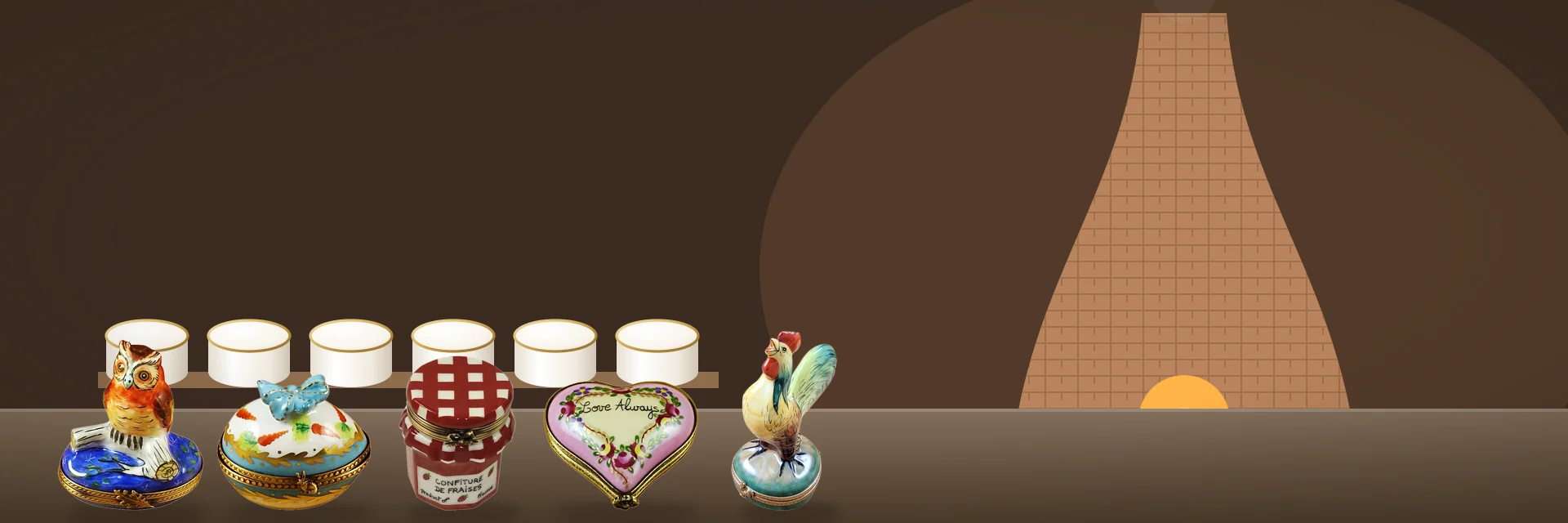 How They're MadeFollow a Limoges box from sculpted model and plaster mold through slip casting, kiln firings, hand painting, gilding…