Limoges Box Guide · Care & Display
Caring for and Displaying Limoges Boxes
Porcelain is tough, but small hinged boxes have weak points. Simple habits for handling, cleaning and display will keep yours looking new for generations.
Fired porcelain is one of the more durable materials in your home. It won’t rot, it doesn’t attract moths, and it doesn’t mind ordinary room temperatures. What it doesn’t survive is a fall onto a hard floor, a knock against another box, or a soak in the sink that loosens the metal mount. Almost every damaged Limoges box we see was hurt by handling or cleaning, not by age.
On this page
This page covers how to pick up and open a box, how to clean the porcelain and the metal, what to do about stiff or loose hinges, how to deal with damage, how to store, move and ship boxes, and how to display them so they look their best and stay safe. Our advice draws on published guidance from conservation bodies such as the Canadian Conservation Institute, adapted for small hinged boxes.
Handling: the basics
Most accidents happen in the few seconds between shelf and hand. A few habits make those seconds safe.
- Clean, dry hands. Wash and dry your hands before handling. Lotion and oils leave smudges and make porcelain slippery. Conservators generally advise bare, clean hands for glazed ceramics, because cotton gloves can slip on a smooth glaze.
- Remove rings and bracelets. Metal and stones can scratch gilt and paint, and a dangling bracelet can catch a raised detail.
- Lift from the base. Support the bottom of the box with one hand and steady it with the other. Never lift by the lid, the clasp, or a raised detail such as a handle, tail or flower.
- Work over a soft surface. When you examine or clean a box, do it over a folded towel on a table, not over a hard floor or a sink.
- Open gently. Hold the base, press or lift the clasp, and raise the lid slowly. Don’t force a lid past its natural stopping point, which strains the hinge.
- One at a time. Carry one box at a time, or several in a padded tray. Don’t stack boxes or set them touching.
Tip: If a box has a loose interior charm, take it out before you move or clean the box, so it doesn’t rattle around and chip the painting inside.
Cleaning
The less you clean, the better. Prevention (a closed cabinet, a clean room) does more than any cleaning routine, because each cleaning adds handling risk.
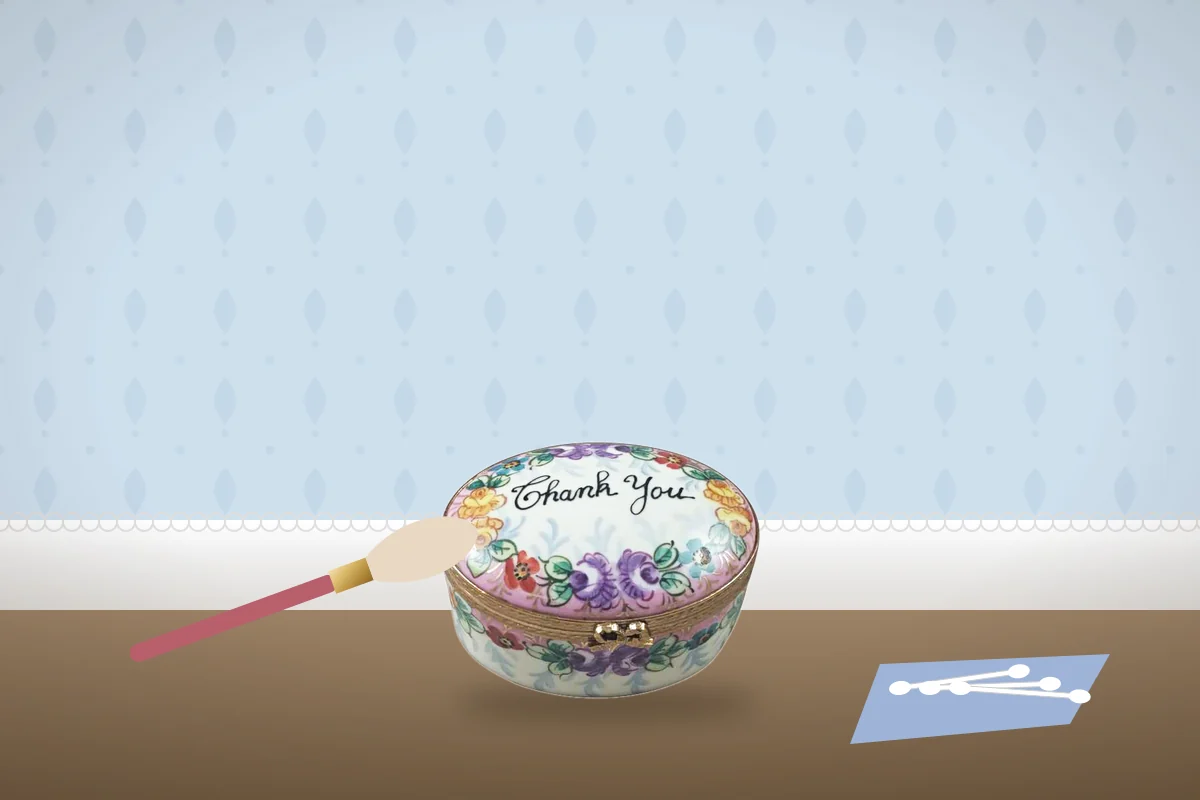
Your cleaning kit
- A soft, clean makeup brush or artist’s brush
- A dry microfiber cloth
- Cotton swabs
- Distilled water in a small cup
- A folded towel to work on
Routine dusting
Brush loose dust away with the soft brush, working from the top down, and pay attention to crevices around raised details. A soft brush is safer than a cloth on detailed surfaces, because cloth can snag on raised parts. On smooth, flat areas, a dry microfiber cloth works well.
When dusting isn’t enough
For a smudge or fingerprint on the porcelain:
- Dip a cotton swab in distilled water and squeeze out most of the moisture. It should be barely damp.
- Test on an inconspicuous spot first, such as the underside.
- Gently roll the swab over the smudge. Don’t scrub, especially over gold trim or painted areas.
- Dry the area right away with a dry swab or the microfiber cloth.
- Keep water well away from the metal mount and hinge.
If the swab picks up color or gold, stop immediately. Some decoration is applied over the glaze and is more fragile than the porcelain itself.
Metal mounts and hinges
The metal frame around the rim is usually fitted by hand and attached with adhesive. It needs very little care.
- Wipe it with a dry microfiber cloth.
- Don’t use metal polish, silver dip or brass cleaner. These products can run onto the porcelain, damage paint and gilding, and weaken the adhesive that holds the mount in place.
- A light, even tarnish on old metal is normal and doesn’t hurt the box. Many collectors prefer to leave it.
What never to do
- Never soak or immerse a box. Water can get under the mount, loosen the adhesive, and corrode the hinge.
- Never put a box in the dishwasher. Heat, detergent and water pressure can strip gold, fade colors and loosen the mount.
- Never use household cleaners, bleach, ammonia, glass spray, abrasive powders or scouring pads.
- Never use heat (a hair dryer, radiator or oven) to dry a box.
- Never try to remove stains with harsh chemicals. If a stain bothers you, consult a conservator.
Hinges: stiff, loose, or broken
Stiff hinges
A new box sometimes has a firm hinge, which usually eases with gentle use. On an older box, dust or old residue can make a hinge stiff.
- Open and close the lid slowly a few times, without forcing it.
- Brush any dust from around the hinge with a dry brush.
- Don’t apply oil, lubricating spray or wax. Oils can wick into the porcelain or stain the paint and are hard to remove. If a hinge is very stiff, ask a professional.
Loose hinges or lids
If a lid wobbles or doesn’t line up with the base, the hinge pin may be worn or the mount may be lifting from the porcelain.
- Stop opening the box until it’s looked at. A loose mount can let the lid fall and chip.
- Don’t reglue it yourself with household glue or superglue. These adhesives can stain, are hard to reverse, and may make a professional repair harder or impossible.
- Consult a ceramics restorer or a conservator.
A broken clasp
If the clasp no longer holds the lid shut, store the box closed with a small strip of acid-free tissue around it, or leave it open on display, until it’s repaired.
Minor damage and professional restoration
Accidents happen. If a box chips or breaks:
- Gather every piece, even tiny fragments, and put them in a labeled envelope or small box.
- Don’t fit the broken edges together repeatedly. Rubbing them wears down the edges and makes a clean repair harder.
- Don’t use household glue. Even a “temporary” fix can complicate a professional repair.
- Take photos for your records and, if relevant, for an insurance claim.
- Find a professional. A ceramics restorer or a conservator can rejoin breaks, fill chips and retouch paint. The American Institute for Conservation runs a “Find a Conservator” directory, and some museums keep lists of local specialists.
Restoration can make a box look whole again, but it rarely restores full value. Decide whether the repair is worthwhile based on the box’s sentimental and market value. Our What’s It Worth? guide explains how damage and repairs affect value. If you sell a restored box, always disclose the repair.
Storage
Boxes you aren’t displaying need a safe, stable home.
- Wrap each box separately in acid-free tissue or a soft cloth pouch. The original pouch, if you have it, is ideal.
- Use the original box when you can. It was made to fit.
- Don’t stack boxes on top of one another.
- Choose a stable spot: an interior closet shelf, away from attics, garages and basements, where temperatures and humidity swing.
- Label the outside of each storage box with its inventory number and a short description, so you don’t have to unwrap boxes to find the one you want. Our Collecting page explains how to set up an inventory.
- Keep interior charms with their boxes, in a small labeled bag inside the wrapping if they’re loose.
Moving and shipping
Moving is the most dangerous time in a box’s life. Pack them yourself rather than leaving them to a mover, and carry the most valuable ones with you if you can.
The box-in-a-box method
- Remove any loose interior charms and wrap them separately.
- Close the lid and wrap the box in acid-free tissue.
- Add a layer of bubble wrap, bubbles facing out, and tape it closed.
- Place it in a small, sturdy carton (the original box is perfect), with padding so it can’t move.
- Place that carton in a larger shipping box with at least two inches of padding on every side.
- Shake gently. If anything shifts, add more padding.
- Mark the outer box “Fragile” and “This side up,” and buy insurance for the shipment.
For shipping, check the carrier’s rules on fragile goods and insurance before you send. When you receive a box, unpack it over a soft surface and inspect it right away, so you can report any damage promptly.
Display ideas
A well-displayed collection is a pleasure to look at, and the right display also protects it.
Closed cabinets
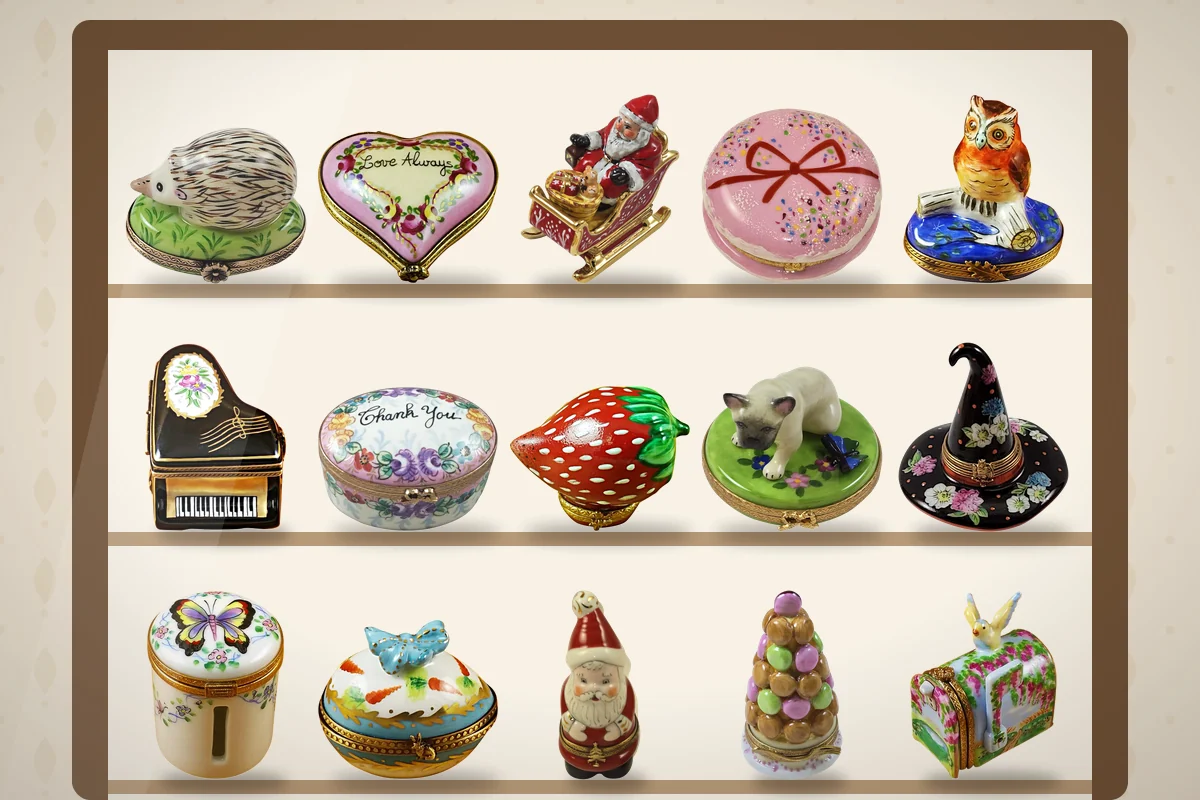
A glass-front curio cabinet is the gold standard. It keeps dust off (so you clean less), protects boxes from bumps and curious hands, and shows them off. Look for:
- Glass shelves for a light, open look, or wood shelves for stability
- A secure door, ideally with a lock if you have children or visitors
- Interior lighting that doesn’t heat up (LEDs are a good choice)
- A mirrored back to show off the backs and sides of boxes
Shadow boxes
Wall-mounted shadow boxes with small individual compartments are ideal for small boxes. Each one sits in its own space, which looks orderly and prevents boxes from knocking into each other. Make sure the shadow box is mounted securely to a wall stud or with suitable anchors.
Risers and stands
Clear acrylic risers let you place boxes at different heights, so back rows aren’t hidden. Small plate stands can show off a box with a painted lid. Keep risers stable and avoid towering arrangements.
Lighting
Good lighting brings out the gold and the brushwork. LED lighting gives off little heat and very little UV light, so it’s a safe choice inside a cabinet. Avoid hot halogen bulbs placed close to boxes, and avoid lights that turn a closed cabinet into an oven.
Grouping by theme
Displays look best when boxes are grouped. Try grouping by:
- Theme (all dogs together, all musical instruments together)
- Color (a shelf of blue boxes, a shelf of pink)
- Story (a “Paris trip” shelf with the Eiffel Tower, a café table and a poodle)
- Size (larger centerpiece boxes at the back, small boxes in front)
Leave a little space between boxes. Crowded shelves look cluttered and make it easy to knock one box into another.
Seasonal rotation
Rotating boxes keeps your display fresh and gives every box its turn. Bring out holiday boxes in December, hearts in February, and garden boxes in spring, while the rest rest safely wrapped in storage. Our Holiday Boxes page has ideas for festive displays, and Shapes & Styles can help you plan groupings.
Protecting your display
Sunlight
Fired porcelain colors are very stable, but direct sunlight heats a box and its surroundings, and over time it can fade nearby fabrics and some materials used in pouches, labels or old repairs. Keep displays out of direct sun, or use UV-filtering window film or glass in a sunny room.
Temperature and humidity
Porcelain is not very sensitive to ordinary room conditions, but the metal mounts and adhesives are. High humidity encourages tarnish and corrosion on the metal, and sharp swings in temperature stress the bond between metal and porcelain. Keep boxes away from radiators, fireplaces, air vents, bathrooms and kitchens. A stable, comfortable living area is ideal.
Earthquakes
If you live in an earthquake-prone area, keep boxes on lower shelves, use cabinets with latching doors, and consider a museum putty or wax (sold under brand names such as Quakehold!). A small dab under the base helps hold a box in place. Conservation references caution that these waxes can stain porous surfaces, so apply them only to the glazed base, test first, and use a small amount. Remove it gently by twisting the box rather than pulling.
Children and pets
- Keep boxes behind closed, ideally locked, glass doors if you have young children or visitors with children.
- Avoid low, open shelves, side tables, and mantels where a cat can walk or a dog’s tail can sweep.
- Secure tall cabinets to the wall with anti-tip straps or brackets.
- Let children enjoy a box with supervision, seated at a table over a towel. That’s often how the next generation of collectors starts.
Photographing your boxes
Good photos help with insurance, inventory, selling and sharing your collection. You don’t need a fancy camera; a modern phone works well.
- Use soft, natural light. Indirect daylight near a window, without direct sun, shows colors accurately.
- Use a plain background. A white or light gray card works for most boxes; dark boxes may look better on a light background.
- Shoot several angles: top, front, sides, the open interior, the hinge, and the base with marks in focus.
- Get close for the marks. Use your phone’s zoom or macro mode, and make sure the writing is sharp.
- Avoid glare. Turn the box slightly or move the light until the reflection on the glaze or gold disappears.
- Include a scale. A small ruler beside the box in one shot shows its size.
- Name your files with the inventory number, so photos match your records.
Frequently asked questions
Can I wash my Limoges box in the sink? No. Water can loosen the mount and damage the hinge. Use a soft brush, and a barely damp swab on the porcelain only for marks.
Should I polish the metal rim? No. Metal polish can damage the paint and gilding and weaken the adhesive. A dry cloth is all it needs.
Is it safe to keep things inside my boxes? Small, light, dry items such as a ring or a folded note are fine. Avoid anything damp, sticky or heavy, and avoid pills or food that can stain.
My lid doesn’t close properly. Can I fix it myself? We don’t recommend it. Bending the mount or regluing it can make things worse. Ask a ceramics restorer.
Will sunlight fade the painting? Fired colors are very stable, but heat and light can affect other materials and the surroundings. It’s still best to keep boxes out of direct sun.
What’s the safest way to display boxes with pets in the house? A closed glass cabinet secured to the wall is the safest choice. See our Collecting page for tips on insurance and records.
For questions about authenticity or marks before you display a new find, see Is It Real? and our Glossary & FAQ. If you’re ready to buy a new box for your display, the team behind this guide offers authorized Rochard and Artoria boxes at LimogesBoutique.com.
Keep reading
 CollectingHow to start and grow a Limoges box collection: choosing a theme, where to buy and how to vet sellers, mistakes to…
 What's It Worth?What makes a Limoges box valuable, how to grade condition, research real sold prices, choose where to sell, and when…
 Holiday BoxesChristmas and holiday Limoges boxes explained: Santa, nutcrackers, ornaments, Hanukkah, Easter and more, plus dated…