
Limoges Box Guide · What's It Worth?
What's My Limoges Box Worth?
There's no price list for Limoges boxes, but there is a reliable way to work out what yours might fetch. Here's what drives value and how to research it yourself.
“What’s it worth?” is the question we hear most often, usually from someone holding a box they’ve inherited or found at the back of a cabinet. The honest answer is that it depends, and that’s not a dodge. Two boxes that look alike at a glance can sell for very different amounts because of who made them, how well they were painted, their condition, and whether anyone is looking for that design right now.
On this page
This page explains the factors that drive value, gives you a condition checklist, shows you how to research real sold prices, and walks through your options for selling. It also explains the difference between an informal estimate and a formal appraisal. We deliberately don’t publish a price list. Any specific number we printed would be out of date quickly and would mislead more readers than it helped.
Before you start, make sure your box is genuine French Limoges. Our Is It Real? guide and Reading the Marks page will help. A box that isn’t authentic Limoges is valued as a general decorative trinket, which is a very different market.
The factors that drive value
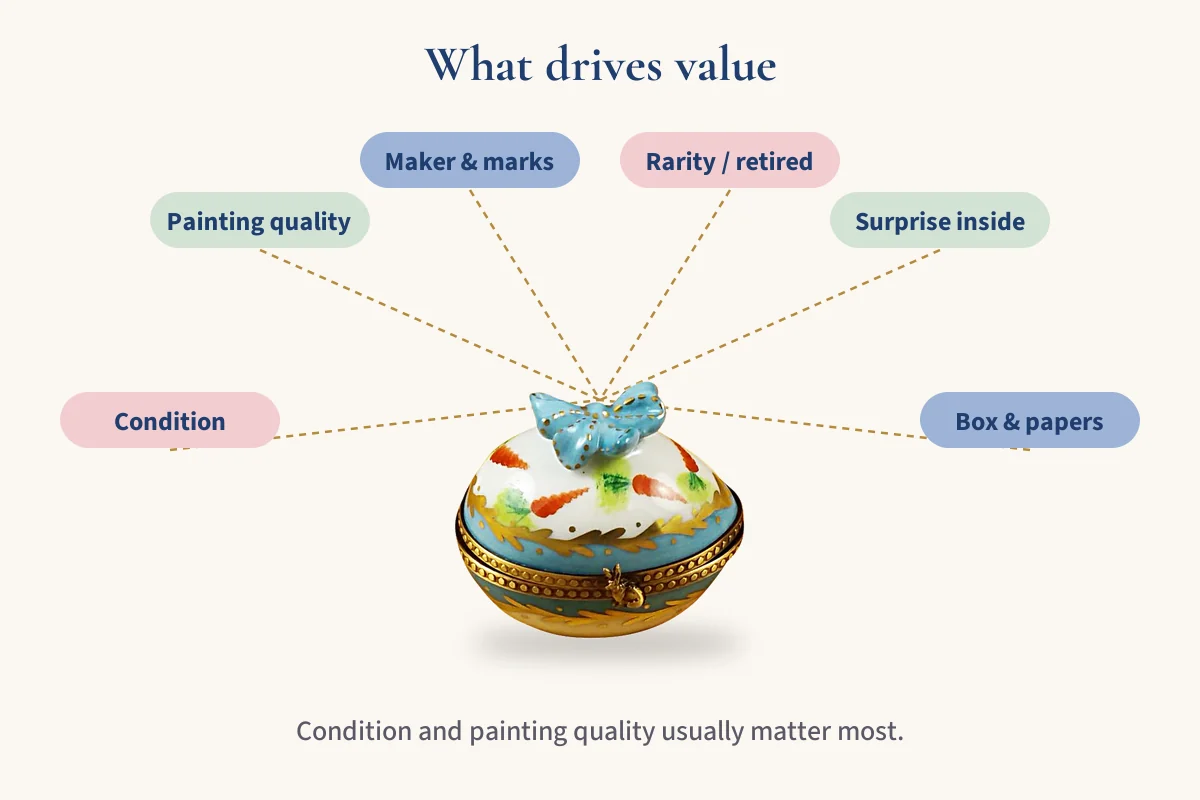
1. Condition
Condition matters more than almost anything else. A small chip on the rim, worn gold trim, or a loose hinge can sharply reduce what a buyer will pay. Restored boxes usually sell for less than undamaged ones, even when the repair is well done, and honest sellers disclose repairs. See the grading checklist below.
2. Maker
Boxes from well-regarded ateliers (workshops) with consistent quality and clear marks tend to attract more buyers. A recognizable maker’s mark reassures a buyer that they’re getting the real thing. Unmarked or vaguely marked boxes are harder to sell, even when they’re genuine. Our page on The Makers explains who’s who.
3. Painting quality
Look closely at the brushwork. Fine detail, clean lines, subtle shading, and crisp gold accents all point to skilled painting. Boxes marked peint main (French for “painted by hand”) should show visible brush strokes under magnification. Painting that looks flat, blurry or printed suggests a decal, which usually brings less. Our page on How They’re Made explains the decorating steps.
4. Rarity and retired designs
When a maker stops producing a model, it’s often described as “retired.” Retired designs can become more desirable over time, but only if collectors actually want them. Retirement alone doesn’t guarantee a rise in value. A retired box in an unpopular subject may sell for less than a current one in a popular subject.
5. Limited editions
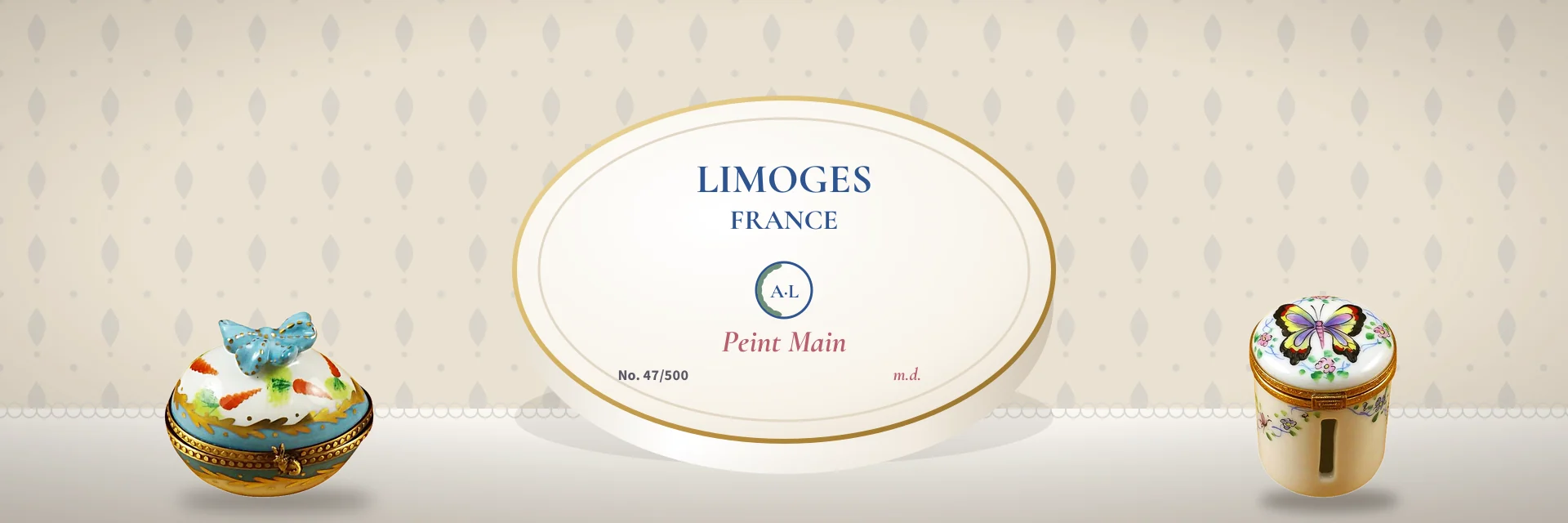
A stated edition (for example, a number like 45/500 on the base) can add appeal, especially when the edition was genuinely small and the paperwork survives. Ask yourself whether the edition size is documented and whether the number matches any certificate. Edition numbers without supporting records carry less weight.
6. Interior surprise
Many boxes hide a tiny porcelain charm or a painted scene inside the lid. Buyers often enjoy these details, and a box missing its loose charm is incomplete. If your box should have a removable piece, check that it’s still there. Interior surprises are one of the details collectors check first.
7. Original packaging and certificates
The original outer box, inner pouch, and certificate of authenticity all add to a box’s appeal on the secondhand market. They show care, help prove origin, and make shipping safer. A collector choosing between two identical boxes will often pay a little more for the one with its packaging.
8. Subject demand
Subject is the wildcard. Popular themes such as certain dog breeds, Christmas, Paris landmarks, music, and weddings tend to attract the most buyers, but tastes shift. A box that commemorates a specific event or a niche hobby may have a smaller pool of interested buyers, which affects price either way.
Summary table
| Factor | Raises value | Lowers value |
|---|---|---|
| Condition | Perfect, no wear | Chips, cracks, paint loss, repairs |
| Maker | Clear, respected atelier mark | Unclear or missing marks |
| Painting | Fine, detailed hand painting | Decals or sloppy brushwork |
| Rarity | Retired, sought-after designs | Common, still widely available |
| Edition | Small, documented edition | Unverified numbering |
| Interior | Charm present, detailed scene | Missing charm |
| Packaging | Original box, pouch, certificate | None |
| Subject | Popular, in-demand themes | Very niche subjects |
Condition-grading checklist
Work through this list in good light with a magnifier. Take notes as you go: you’ll need them for listings, appraisals and insurance.
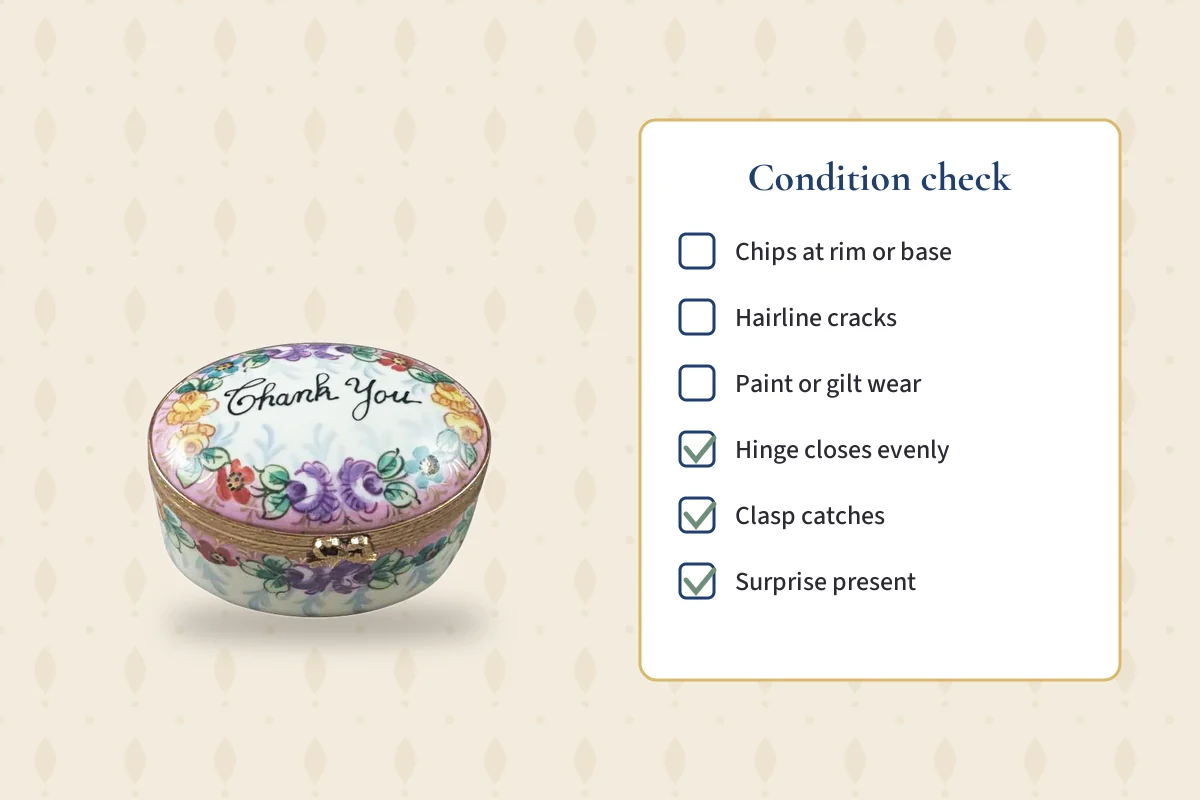
Porcelain body – [ ] Rim of the base and lid: run a fingertip gently around each edge. Any chips, rough spots or “fleabites” (very small chips)? – [ ] Hairline cracks: hold the box up to a bright light. Fine lines that don’t wipe away may be cracks. – [ ] Base: any chips on the bottom edge or feet? – [ ] Raised details (handles, flowers, tails, ears): any breaks or missing pieces?
Painting and gilding – [ ] Paint loss or rubbing on high points – [ ] Gold trim: bright, or worn and patchy? – [ ] Discoloration, stains or crazing (fine cracks in the glaze surface)
Metal mount and hinge – [ ] Hinge opens and closes smoothly – [ ] Lid lines up evenly with the base – [ ] Clasp holds the lid closed – [ ] Mount firmly attached, with no gaps or lifting – [ ] Metal finish: any heavy tarnish, green corrosion or scratches?
Interior – [ ] Charm or surprise present, if there should be one – [ ] Interior painting intact
Repairs – [ ] Areas that look slightly different in color, sheen or texture (possible restoration) – [ ] Under a UV flashlight, some repairs show up differently from original glaze (not a guarantee, but a useful hint)
Completeness – [ ] Original packaging – [ ] Certificate or paperwork
A simple grading scale
| Grade | What it means |
|---|---|
| Mint | Like new, no flaws, ideally with packaging |
| Excellent | Very minor wear visible only on close inspection |
| Good | Light wear to gilt or paint, sound hinge, no chips |
| Fair | Small chips, noticeable wear, or hinge problems |
| Damaged or restored | Cracks, breaks, missing parts, or professional repair |
How to research comparable sold prices
The best guide to value is what similar boxes have actually sold for, not what sellers are asking. Asking prices can be far too high or far too low, and a listing sitting unsold for months tells you little.
Step 1: Identify your box as precisely as you can
Note the maker’s mark, any model name or number, the subject, size, and any edition number. The more precise you are, the better your comparisons will be.
Step 2: Search sold listings
Most large online marketplaces let you filter results to show sold or completed items. On eBay, for example, you can run a search and then tick the “Sold items” filter. Search using the maker name plus the subject (“Rochard piano box,” “Limoges dachshund box”) and try several variations.
Step 3: Check auction records
Auction houses often publish past results, and some online services gather auction results from many sales. Look for boxes of the same maker, subject and condition. Remember that auction results include or exclude buyer’s premiums depending on how they’re reported.
Step 4: Compare like with like
Match condition, packaging, maker and size as closely as you can. A mint box with packaging and a chipped box without it are not comparable, even if they show the same subject.
Step 5: Look at a range, not a single sale
Collect at least five comparable sales if you can. Ignore extreme highs and lows, and look at where most sales cluster. That cluster is a more realistic estimate than any single result.
Step 6: Consult reference books
Collectors’ references such as Faye Strumpf’s Limoges Boxes and Mary Frank Gaston’s books on Limoges porcelain can help with identification. Any prices printed in older books are likely to be out of date, so use them for identification rather than current values.
Tip: Take a screenshot of each comparable sale and save it with your records. Listings disappear, and you’ll want this evidence if you insure or sell.
Broad value ranges
We don’t publish prices, but some general patterns hold. Values vary widely, so treat these as rough tendencies, not promises.
- Most secondhand boxes in good condition sell for less than their original retail price. This is normal for decorative collectibles.
- Common designs that are still widely available usually sell for modest amounts on the resale market.
- Sought-after retired designs, boxes with fine painting from respected makers, and those in mint condition with packaging can hold their value better and occasionally sell above their original price.
- Damaged boxes generally sell for a small fraction of what an undamaged example would bring, unless the design is rare.
- Antique boxes (18th and 19th century) are a separate, specialist market and should be assessed by an expert, not compared to modern trinket boxes.
Options for selling
| Option | Pros | Cons |
|---|---|---|
| Online marketplace | Large audience; you set the price | Time spent photographing and listing; selling fees; shipping risk; returns |
| Auction house | Expert cataloguing; reaches serious collectors; good for whole collections | Seller’s commission; may not accept single low-value boxes; outcome uncertain |
| Consignment shop | Someone else handles the sale | Commission; can take a long time; limited local audience |
| Antique dealer | Quick, simple sale | Dealers need to resell at a profit, so offers are usually lower |
| Estate sale company | Handles a full household at once | Commission; boxes may be priced quickly rather than researched |
| Private sale to collectors | Can bring good prices for sought-after pieces | You need to find buyers; payment and trust issues |
Tips for any sale
- Photograph the box well: top, sides, interior, and base marks.
- Describe condition honestly, including any repairs. Undisclosed damage leads to returns and bad feedback.
- Mention packaging, certificates and edition numbers.
- Pack carefully. See our Care & Display page for shipping advice.
Appraisals vs. estimates
An estimate is an informal opinion of what a box might sell for. Dealers and auction houses often give estimates for free, especially when they hope to sell the piece for you. Estimates are useful, but they aren’t formal valuations, and they may reflect the estimator’s own interest.
An appraisal is a formal written report from a qualified appraiser. It describes the item, explains the method used, and gives a value for a specific purpose (such as insurance, estate settlement or charitable donation). In the US, credentialed personal-property appraisers commonly follow USPAP (the Uniform Standards of Professional Appraisal Practice).
Finding an appraiser
- Look for members of recognized professional groups such as the American Society of Appraisers, the Appraisers Association of America, or the International Society of Appraisers.
- Ask whether they have experience with porcelain or decorative arts.
- Ask how they charge. Hourly or flat fees are normal. Be wary of anyone who wants to charge a percentage of the appraised value, which professional appraisal standards generally consider a conflict of interest.
- Ask whether they’ll also offer to buy the item. An appraiser who also bids has a conflict.
Insurance valuation
Appraisals for insurance usually give a replacement value: what it would cost to buy a comparable item, often at retail, today. That is typically higher than fair market value, which is what a willing buyer would pay a willing seller, and which is used for estates, donations and sales. Don’t be surprised if your insurance figure is higher than what you could get by selling.
Values change, so it’s sensible to update insurance appraisals every few years or after large market shifts. Keep copies with your inventory. Our Collecting page explains what to record and how scheduled coverage works.
A worked example
Say you’ve inherited a box with a clear maker’s mark, peint main on the base, a small chip on the lid rim, and no packaging. Start by grading it (“Fair”: small chip, no packaging). Search sold listings for the same maker and subject, and set aside results for mint boxes with packaging. Look at what chipped or unboxed examples have brought. If most cluster in a narrow band, that’s your realistic expectation. If the box turns out to be a rare retired design, consider asking an auction house for an estimate before listing it yourself.
Frequently asked questions
Are Limoges boxes a good investment? Most are best thought of as things to enjoy, not investments. Some retired or rare boxes hold their value, but many sell for less than their original price.
Does “Limoges” on the base mean it’s valuable? No. “Limoges” alone doesn’t prove a box was hand painted in France. Check the full set of marks described in our marks guide.
Should I repair a chipped box before selling? Usually not. Professional restoration can cost more than it adds, and buyers prefer to know what they’re getting. Disclose the chip and let the buyer decide.
Do older boxes always sell for more? Not always. A recent, sought-after design in mint condition can outsell an older, common or damaged one. Antique boxes are a specialist area.
Can I get a free appraisal online? You can get free informal opinions, but a formal appraisal for insurance or estates requires a qualified appraiser and usually involves a fee.
What words from the base should I know? Our Glossary & FAQ explains peint main, rehaussé main and other common terms.
If you’re ready to buy a new box with certainty about its maker and condition, the team behind this guide sells authorized Rochard and Artoria boxes at LimogesBoutique.com.
Keep reading
 CollectingHow to start and grow a Limoges box collection: choosing a theme, where to buy and how to vet sellers, mistakes to…
 Reading the MarksDecode the marks on a Limoges box: Limoges France, Peint Main, workshop and importer names, painter's initials,…
 Care & DisplayHow to handle, clean, store, ship and display Limoges boxes safely: hinge problems, damage and restoration,…