Limoges Box Guide · Holiday Boxes
Christmas and Holiday Limoges Boxes
Holiday boxes are where many collections begin. Here is what to look for, how to build a yearly tradition, and how to display and store them so they last for generations.
Ask a longtime collector how they started, and the answer is often “with a Christmas box.” Holiday Limoges boxes are small, cheerful and easy to give, and because the holidays come around every year, they lend themselves to tradition: one new box each December, a box for each grandchild, a box that comes out of the attic with the stockings.
On this page
This guide covers the main holiday themes, dated and annual editions, ways to build a tradition, seasonal display, careful off-season storage, and when to buy.
Christmas themes
Christmas is by far the largest holiday category. Within it, a few themes dominate.
Santa Claus
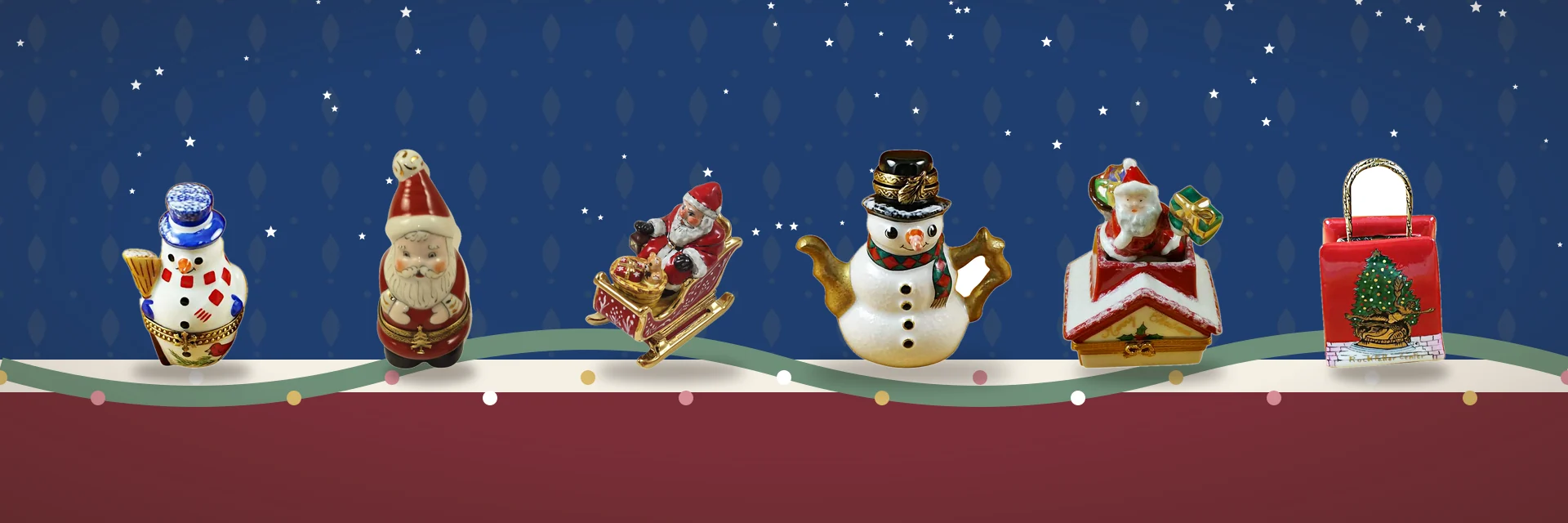
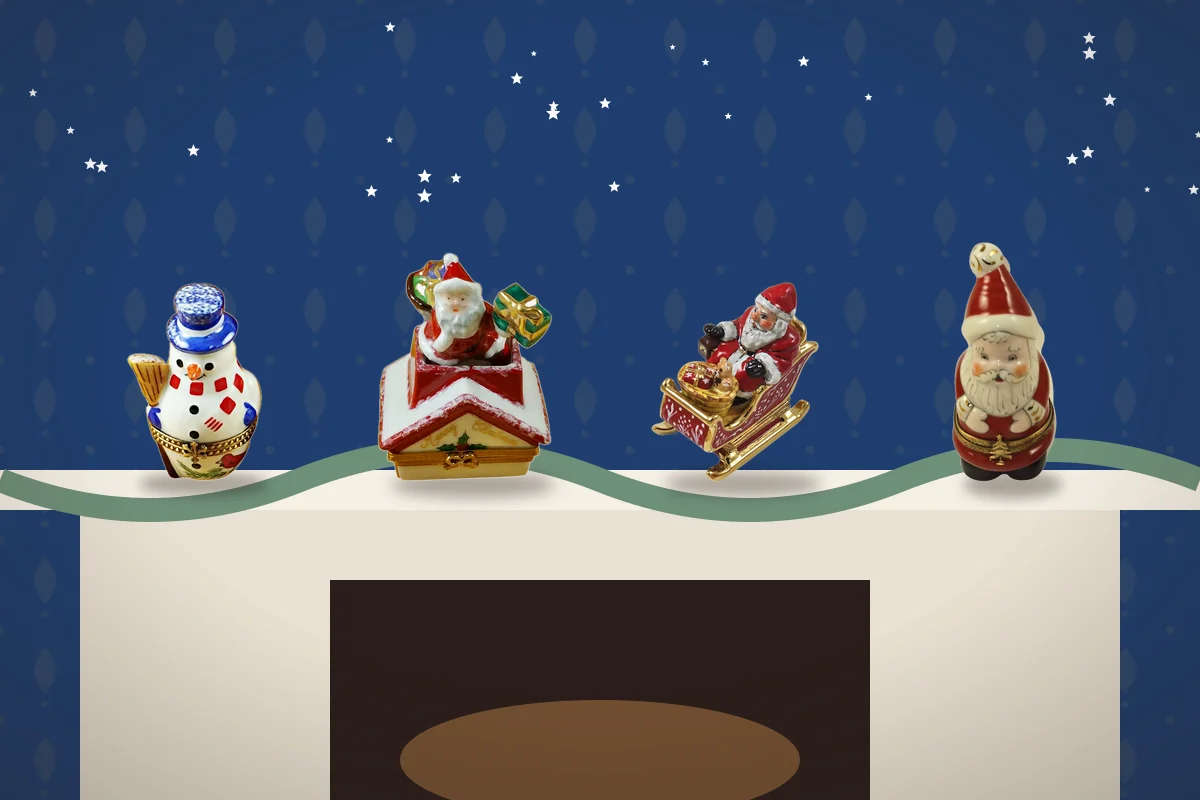
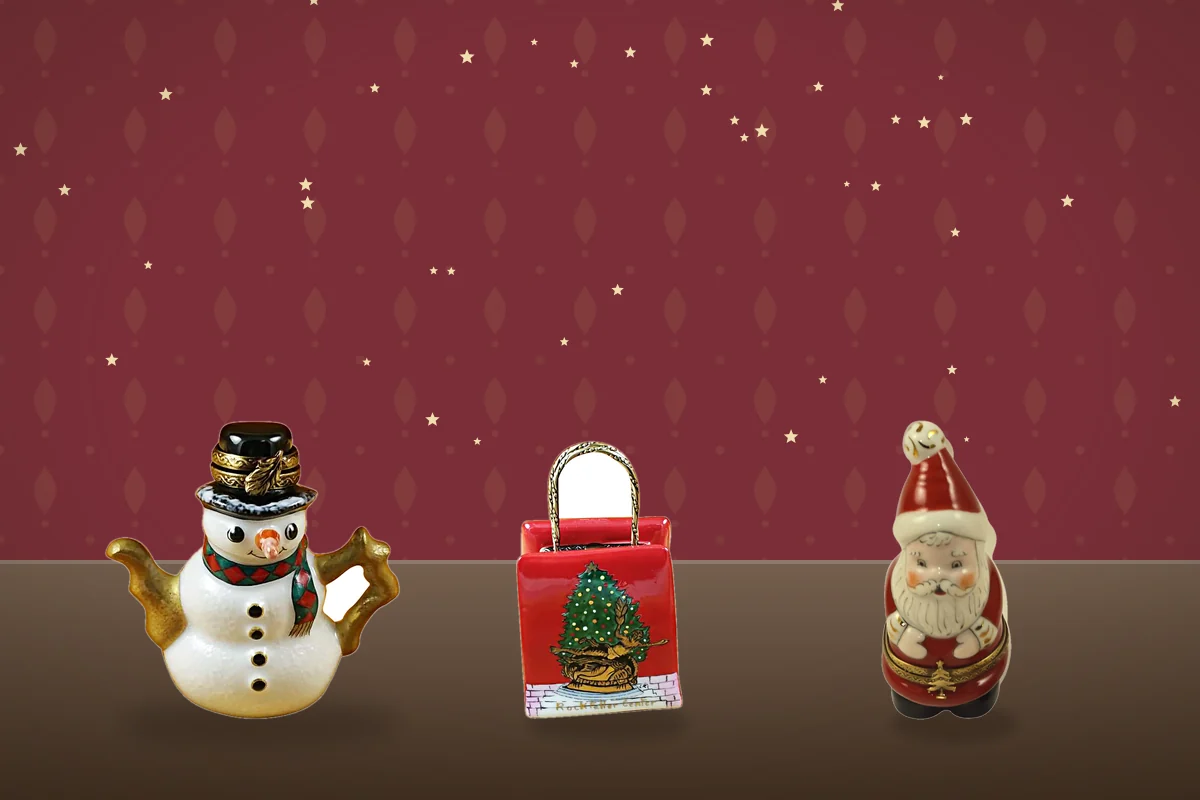
Santa appears in every possible form: a round-bellied Santa standing, Santa in his sleigh, Santa going down a chimney, Santa with a sack of toys, Santa’s boot or hat on its own. Look for crisp painting on the white fur trim and the face, which are hard to do well at small scale. Santa boxes often hide a tiny toy or present inside.
Nutcrackers
The soldier nutcracker owes its look to the toymakers of Germany’s Erzgebirge (Ore Mountains). Wilhelm Füchtner of Seiffen is widely credited with making the first nutcrackers in the now-classic soldier-and-king style in the early 1870s, and Tchaikovsky’s ballet The Nutcracker (1892) helped make the figure a Christmas symbol around the world. Limoges nutcracker boxes copy the bright uniforms, tall hats and stiff pose, and are popular with ballet lovers and families who attend the ballet each year.
Ornaments
Ornament-shaped boxes, round baubles, teardrops, stars and bells, are a natural fit for porcelain. Many have a small loop at the top. Some can be hung on a sturdy branch, but most are better displayed on a stand or in a bowl, since a fall onto a hard floor will break them.
Christmas trees
Trees range from simple green cones with painted garlands to elaborate decorated trees with presents at the base. They often open around the middle or at the base, and are one of the most popular first holiday boxes.
Other Christmas favorites
- Snowmen, snowflakes and mittens
- Wreaths and candles
- Fireplaces with hung stockings
- Gingerbread houses and cookies
- Reindeer, angels and nativity scenes
- Wrapped presents, often in red and gold
- Holiday trains, sleds and village houses
Tip: If the box is a gift for someone who decorates in a particular palette (traditional red and green, silver and blue, or gold and white), match it. It will then earn a spot on the mantel every year.
Other holidays
Holiday boxes are not only for Christmas. Collectors often build a full year of seasonal displays.
| Holiday | Common designs |
|---|---|
| Hanukkah | Menorahs, dreidels, Stars of David, blue-and-white gift boxes |
| Valentine’s Day | Hearts, roses, love letters, cupids, chocolate boxes |
| Easter | Painted eggs, bunnies, chicks, baskets, lilies |
| Mother’s Day | Flowers, teacups, hearts |
| Fourth of July | Flags, Uncle Sam hats, fireworks |
| Halloween | Pumpkins, black cats, witches’ hats, haunted houses |
| Thanksgiving | Turkeys, cornucopias, pumpkin pies, Pilgrim hats |
| New Year’s | Champagne, clocks, party hats |
Hanukkah
Hanukkah boxes, such as menorahs and dreidels, make thoughtful gifts for Jewish friends and family and for interfaith households that celebrate both holidays. Hanukkah moves on the Western calendar from year to year; in 2026 it begins at sundown on Friday, December 4, so plan earlier than you would for Christmas.
Easter
The egg is an especially fitting Easter shape for porcelain, and Easter boxes lean into pastel colors and spring flowers. Bunny and chick boxes are popular with children and grandparents alike.
Valentine’s Day
Heart boxes are the classic Valentine’s gift. Many people slip a small piece of jewelry inside, which turns a modest gift into a memorable one.
Halloween and Thanksgiving
Fall holidays are an underrated category. Pumpkins, black cats and turkeys make a fun autumn display, and because fewer people collect them, they can make a collection feel distinctive.
Dated and annual editions
Some makers issue holiday designs marked with the year, either painted on the box or noted on the base or packaging. Others release an annual design without a date on the porcelain. Either way, the appeal is the same: each box marks a particular season.
Dated boxes are ideal for:
- Baby’s first Christmas: a box dated with the child’s birth year.
- A couple’s first Christmas together.
- An annual series: one dated box a year, building a timeline.
- Memorial gifts: a box marking the year someone was lost.
If you are building a dated series, buy each year’s box during that season, since dated designs are often made in limited quantities and may be hard to find later. Keep the original packaging and any accompanying card. For notes on documenting a collection, see Collecting, and for whether dated boxes are worth more, see What’s It Worth?.
Good to know: If a box only says “Limoges” and a date, check the marks carefully before assuming it is a genuine hand-painted French piece. Our Is It Real? and Reading the Marks guides explain what to look for.
Building a holiday tradition
The appeal of holiday boxes is that they grow with a family. A few traditions that work well:
One box a year for each child. Start at birth or first Christmas. By age 18, a child has a small collection that tells the story of their childhood, and something meaningful to take to their first home.
A box for each grandchild, chosen to match their interests that year. A dinosaur at five, a soccer ball at ten, a guitar at fifteen. Write the year and the reason on a card kept inside the box’s packaging.
A couple’s ornament box. Each December, choose one box together that reflects the year: a trip, a new house, a new baby, a new dog.
A surprise hunt. Many holiday boxes contain a small charm or painted surprise inside. Some families hide the year’s new box in the tree and let the youngest person find it.
The advent box. Place a single wrapped candy or a small note inside a box and set it out on December 1. It becomes part of the countdown every year.
Say your mother has six holiday boxes she has bought over the years. You could add a seventh that reflects something specific to this year, for example a little house box if she moved, and write a card noting why. A few years later, that box carries a memory, not just a theme.
Displaying holiday boxes
Holiday boxes look best grouped. A single box on a big mantel gets lost; seven or eight together form a scene.
Display ideas:
- The mantel: arrange boxes on a runner of greenery or felt, varying heights with small stands or stacked books under the cloth.
- A tray or cake stand: a tiered stand makes a lovely table centerpiece and keeps boxes contained.
- A glass cloche or shadow box: protects from dust and curious hands.
- A window ledge vignette: a village of house and tree boxes, lit by the window during the day.
- A curio cabinet shelf: reserve one shelf for the season and swap the display each holiday.
Practical display cautions:
- Keep boxes away from candles, fireplace heat and radiators.
- Avoid placing them where pets, toddlers or swinging coats can knock them off.
- Don’t hang porcelain ornament boxes on a live tree with weak branches; set them in the tree’s lower boughs or on a stand instead.
- Use a small dot of museum putty under each box on busy surfaces to prevent slips.
See Care & Display for more on cabinets, lighting and cleaning.
Storing boxes off-season
Most damage to holiday boxes happens during packing and unpacking, not during display. A little care each January prevents chips and lost charms.
- Dust gently with a soft brush or dry cloth before storing.
- Check for loose charms. Remove any loose surprise and wrap it separately, or tape it inside a small labeled envelope.
- Close the clasp carefully, but don’t force a stiff one.
- Wrap each box individually in acid-free tissue. Avoid newspaper, which can transfer ink, and avoid bubble wrap directly against painted and gilt surfaces, since it can trap moisture.
- Use the original boxes if you have them; they are designed to fit.
- Pack in a sturdy, divided container, such as an ornament storage box, with the heaviest pieces at the bottom.
- Label the container with “Fragile: porcelain” and a list of contents.
- Store somewhere stable: a closet shelf inside the home is better than an attic or garage, where heat, cold and damp can affect the metal mounts and glue.
Tip: Take a quick phone photo of your full display before you pack it up. Next year you can recreate it in minutes, and you’ll have a record of every box for insurance purposes.
Gift timing
Holiday boxes are popular, so timing matters.
- Early fall (September to October): the widest selection, including dated designs. Best time to find a specific theme or a series addition.
- November: still good choice, but popular designs can sell out.
- December: allow extra time for shipping; carriers are busy and porcelain needs careful packing. Order well before the middle of the month for Christmas delivery.
- After the holidays: a good time to buy for next year, though dated designs may be gone.
- Other holidays: for Valentine’s, Easter and Mother’s Day, aim for three to four weeks ahead.
For gift ideas beyond the holidays, see Gift Ideas, and for the full range of designs, see Shapes & Styles. If you’re ready to buy, LimogesBoutique.com carries a selection of hand-painted Christmas and holiday Limoges boxes.
FAQ
Can I hang a Limoges ornament box on the tree? Some have loops, but porcelain is heavy for its size and breaks if dropped. A sturdy lower branch, a stand or a bowl is safer.
Are dated Christmas boxes good investments? Buy them for pleasure and memory, not as an investment. Some dated designs become harder to find, but values vary widely and depend on condition, maker and demand.
What’s a good first holiday box? A Christmas tree, Santa or a simple ornament shape. They suit almost any home and start a collection naturally.
How do I keep track of loose charms? Store them in a labeled envelope taped inside the box’s original packaging, and check for them before unwrapping or wrapping.
Are there Limoges boxes for Hanukkah? Yes. Menorah and dreidel designs are the most common, and blue-and-white designs suit the season.
Keep reading
 Gift IdeasLimoges box gift ideas by occasion: weddings, anniversaries, babies, birthdays, retirement, men and collectors, plus…
 Care & DisplayHow to handle, clean, store, ship and display Limoges boxes safely: hinge problems, damage and restoration,…
 Shapes & StylesA plain guide to Limoges box shapes and styles: classic ovals and hearts, figural themes, surprises inside, sizes,…